ChatGPT visual ads: the new image ad format, measurement partners and brand safety
 Tarun Kapoor
Updated 16 October 2026
84 min read
Tarun Kapoor
Updated 16 October 2026
84 min read
OpenAI's new ChatGPT visual ad format is an image-led sponsored unit, first tested during image generation for US users on the Free and Go plans, that shows product inspiration, product usage or the experiences a product makes possible. It was announced on 15 October 2026 together with a much larger measurement ecosystem (Hightouch, Tealium and LiveRamp for signals, ten attribution partners, geo-based incrementality tests and brand-lift studies) and new brand-safety controls, including Negative Phrases and DoubleVerify and IAS evaluation pilots. This guide sets out what is confirmed, what is not yet published, and how to prepare creative, measurement and brand-safety plans so you are ready when access opens.
The short version
- What shipped (15 October 2026): OpenAI announced a new visual ad format for ChatGPT, a wider set of measurement integrations and partners, and brand suitability pilots with DoubleVerify and Integral Ad Science.
- Where the visual format runs first: during image generation in ChatGPT, for users on the Free and Go plans, in the US, with an initial group of advertisers. OpenAI said testing begins “later this month”, which means late October 2026.
- The rules that do not change: ads are clearly labelled, they sit apart from the image being created, and OpenAI says advertising does not influence ChatGPT's answers.
- Measurement: Hightouch, Tealium and LiveRamp for sending conversion data; ten attribution partners including AppsFlyer, Triple Whale, Northbeam and DV Rockerbox; Fospha, Measured and INCRMNTAL for full-funnel work; geo-based incrementality tests with Haus, Measured and WorkMagic; early brand-lift testing with Kantar and Cint.
- Brand safety: placement guardrails keep ads out of sensitive conversations. Negative Phrases are now available to qualifying advertisers. DV and IAS will evaluate the safeguards in a controlled test environment without seeing real user conversations.
- Not published yet: image specs, pricing, bidding model, targeting controls and how to opt in to the visual format. This guide keeps confirmed facts and my inferences separate and labels which is which.
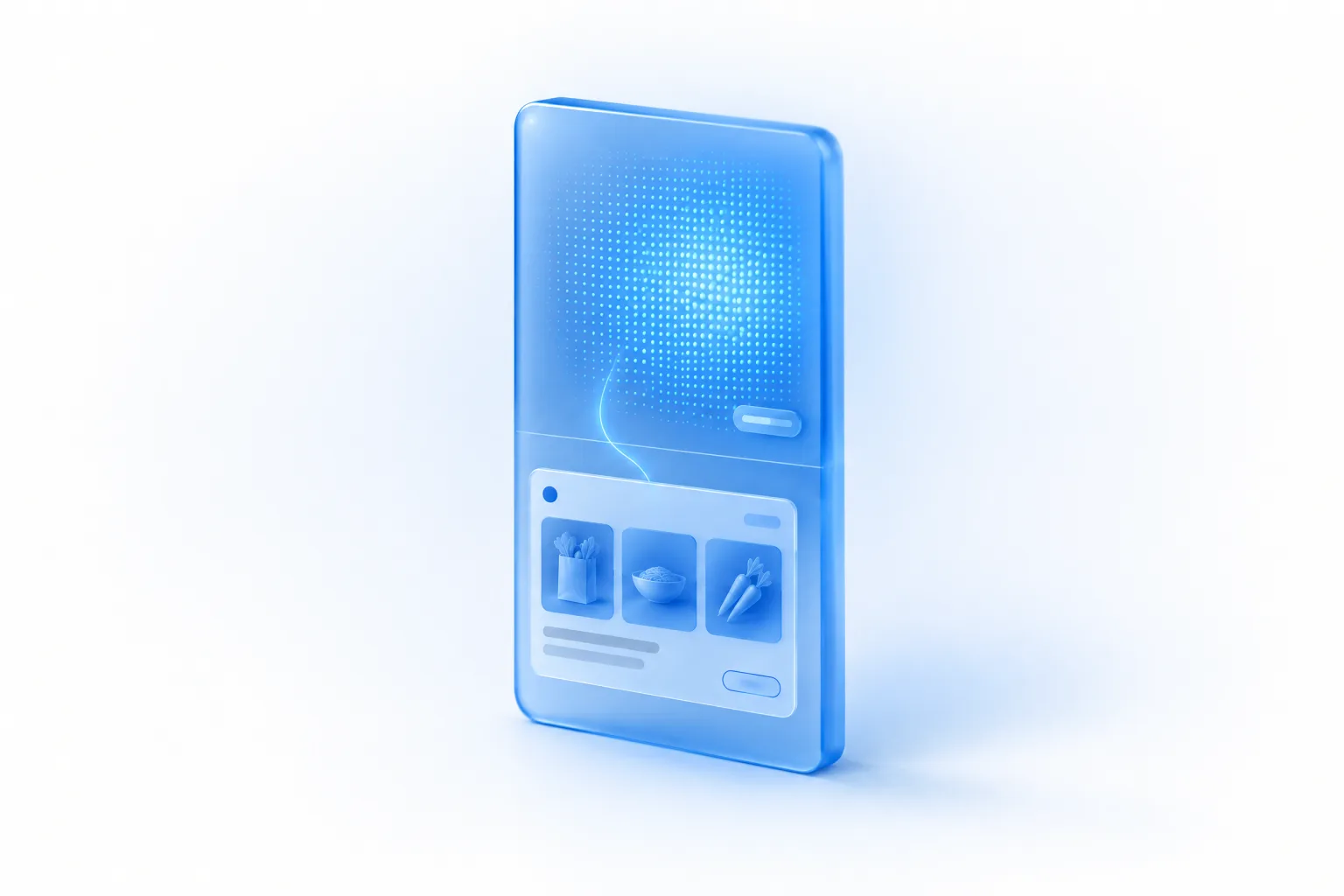
What OpenAI announced on 15 October 2026
On 15 October 2026 OpenAI published a post called “Building advertising for the way people use AI.” It made three announcements together. The first is a new visual ad format for ChatGPT. The second is a larger set of measurement tools and third-party partners. The third is a set of brand suitability pilots with independent verification companies. A companion post on the OpenAI Ads blog, “More ways to measure ChatGPT Ads”, dated 5 October 2026, gives the detail on measurement: the partner list, five early results from partners, and new information on view-through conversions.
Most coverage will lead with the visual format, and fair enough: it is the first new kind of ad placement since the platform launched. For most advertisers spending money today, though, the measurement news matters more in the short run. You can't buy the visual format yet, unless you are in the first test group, but most advertisers can use the measurement changes now. This guide covers both. I take each part of the announcement in turn and translate it into what you can do, what you should prepare, and what you should not assume.
Here is the announcement in one table, before the detail:
| Pillar | What was announced | Status | Who it affects first |
|---|---|---|---|
| Visual ad format | Image-led ads that show product inspiration, product usage, or the experiences a product makes possible | Testing “later this month” (October 2026), US only, initial advertiser group | Consumer brands with strong imagery, first-wave test advertisers |
| Signal integrations | Hightouch, Tealium and LiveRamp send conversion data into ChatGPT Ads | Announced as available | Advertisers with a CDP, warehouse or identity platform |
| Attribution partners | AppsFlyer, Triple Whale, Adjust, DV Rockerbox, Northbeam, Branch, Singular, Kochava, Airbridge, Tenjin | Supported: Conversions API, reporting, click attribution | App advertisers (MMPs) and ecommerce brands (MTA tools) |
| Full-funnel measurement | Fospha, Measured, INCRMNTAL | Partnerships announced | Brands running media-mix or always-on incrementality models |
| Incrementality | Geo-based experiments with Haus, Measured and WorkMagic | “Early stages”, exploratory | Larger budgets that can power a geo test |
| Brand measurement | Early-stage testing with Kantar and Cint on brand resonance metrics | Early testing, tied to new placements | Brand-led advertisers |
| Brand suitability | Negative Phrases for qualifying advertisers; DV and IAS evaluation pilots | Negative Phrases available; pilots in development | Brands with strict suitability policies |
Two framing statements from OpenAI matter for everything below. First, the reach claim: OpenAI says ChatGPT reaches 1.2 billion people each week and calls it “the world's largest AI-native consumer platform.” Second, the purpose: OpenAI presents advertising as the way it serves a much larger market than subscriptions alone, while giving businesses a way to reach people as they explore ideas, make decisions and discover products. That framing explains why the visual format sits where it does. Image generation is one of the most popular things people do in ChatGPT. It is also one of the few moments when the user is waiting and looking at the screen with nothing to read.
A note on how to read this guide. OpenAI has published the format's purpose, placement, audience, labelling rules and launch timing. It has not published creative specifications, pricing, bidding options or targeting controls for the visual format. Where I describe the ad unit's layout, I am reading OpenAI's own published mockup, not a spec sheet, and I say so. Where I give strategy, it is my operating judgement as someone who has bought media for twelve years. It is not OpenAI guidance. Treat those sections as a plan to test, not settled fact.
What is the ChatGPT visual ad format?
The ChatGPT visual ad format is an image-led sponsored unit that helps people picture how a product or service could fit into their lives. OpenAI describes three kinds of image it is built for: product inspiration, product usage, and the experiences a product makes possible. The stated goal is for people to discover a new brand, understand what makes an offer distinctive, and decide what to buy. For advertisers, OpenAI says, it creates new chances to tell their story through images.
This is a real change. Since the February 2026 pilot, the standard ChatGPT ad has been a compact sponsored card under a response. It has an advertiser name and favicon, a short headline, a short description and a small square image. I take that unit apart element by element in the anatomy of a ChatGPT ad. Its image has been a recognition device, a thumbnail that helps a reader place the brand, and not the point of the ad. Product feed campaigns added a multi-product carousel in August 2026, but that is a catalog unit generated from feed data. The new format makes imagery the main message and puts it in a placement built around images.
Where it appears: during image generation
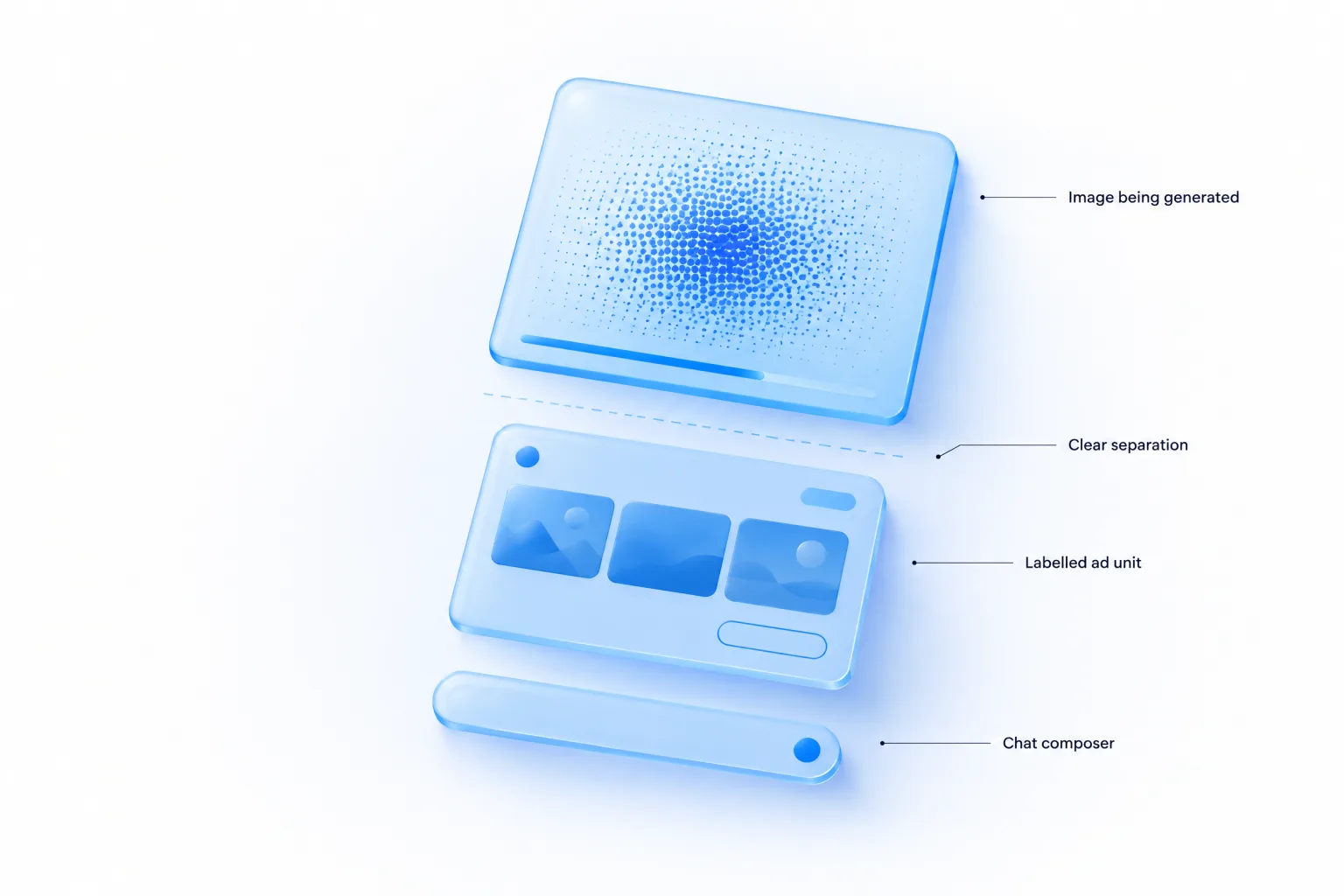
OpenAI says the format will first be tested during image generation in ChatGPT. When a user asks ChatGPT to create an image, generation takes a while. The image fills in progressively, and in OpenAI's mockup a progress indicator reads 62%. The visual ad appears in that window, below the image being created and above the chat composer.
OpenAI states three rules for this placement. Ads will be clearly labelled. They remain separate from the image being created. And, as with OpenAI's other ad formats, advertising does not influence the answers ChatGPT provides. In image generation, “the answer” is the generated image. So the commitment means an advertiser cannot buy their way into the user's picture. A grocery brand's bag will not appear in your generated dinner-party scene because the brand bought an ad. The ad sits next to the output. It does not shape it.
Who sees it
The test is limited to users on the Free and Go plans, the same audience that sees ChatGPT ads today. Plus, Pro, Business and Enterprise users have never been shown ads, and nothing in this announcement changes that. OpenAI's wider ads rules still apply: no ads for users who declare they are under 18 or are predicted to be, and no ads in sensitive conversations (more on that in the brand safety section). The test is US only at first, even though standard ChatGPT ads now run in more than a dozen markets.
When and with whom
OpenAI says testing “will begin later this month in the US with an initial group of advertisers.” The post is dated 15 October 2026, so that means the second half of October 2026. It is a test, not a general launch. Expect small volume, changing creative rules, and reporting that may lag behind the standard unit. That is how every ChatGPT ads capability has rolled out so far. The text ad went from a managed pilot with reported six-figure commitments in February 2026 to self-serve with no minimum spend by May 5, 2026. If the visual format follows that path, the first wave is managed and selective, and broad access comes months later. That is a guess from the pattern, not an OpenAI commitment.
Anatomy of the visual unit, read from OpenAI's mockup
OpenAI has not published a spec sheet for the visual format. It did publish a mockup: two ChatGPT mobile screens showing a fictional advertiser, “Heirloom Grocery”, running a visual ad during image generation. A mockup is not a contract. Production units often differ from launch images. But it is the best evidence available of what OpenAI is building, and it shows several design decisions worth reading closely.
The shared elements
Both screens show the same structure from top to bottom:
- The generation canvas. The top of the screen is the image being generated, drawn as a halftone dot field with a progress chip reading 62%. A thin rule separates it from everything below.
- Advertiser identity. A circular badge with the letter “H” and the name “Heirloom Grocery”. This matches how the standard unit identifies advertisers by name and icon.
- The “Ad” label. A small pill reading “Ad” at the top right. The standard ChatGPT unit is marked “Sponsored”, and the mockup's “Ad” may be a compact label for the visual context. Treat the exact wording as unconfirmed. The commitment that matters is that it is clearly labelled.
- An overflow menu. A “…” icon next to the label. In other ad systems this is where users hide an ad, report it, or learn why they saw it. OpenAI's principles stress user control, so expect controls here, though the mockup doesn't show them.
- The visual. This is where the two screens differ. See below.
- Headline. “Fresh Groceries for Easy Weeknight Dinners”, 42 characters over two lines. That is longer than the headline lengths reported for the standard unit, which suggests the visual format may allow, or at least display, a longer line. Unconfirmed.
- Call-to-action button. An outlined “Learn more” capsule. The standard text unit has never offered a CTA button picker. If the visual format has CTA labels, that is new. Whether advertisers can choose the label is unknown.
- The composer. The “Ask ChatGPT” input sits below the ad, with a stop button showing that generation is still running. So the ad shows while the user waits, not after the image is done.
Two layouts: a hero frame and a scrolling row
The two screens show the same ad laid out two ways.
The single hero frame (left screen). The ad is one wide rounded card with a mint-to-teal gradient. Bold headline type is set into the image itself: “Fresh ideas for dinner.” A product still life of a paper grocery bag, baguette, basil, tomatoes, avocado and lemon fills the right half. Five dots near the bottom, the first one elongated, show this is one frame of a swipeable sequence of about five. The advertiser badge and “Ad” label sit inside the image area.
The scrolling multi-image row (right screen). Here the advertiser name and label sit above the imagery on a plain background. The visual is a horizontal row of square images: a grocery bag on a green backdrop, an overhead shot of pesto pasta, and a third tile (carrots in a basket) cut off at the right edge to show the row scrolls. There is no type in the images.
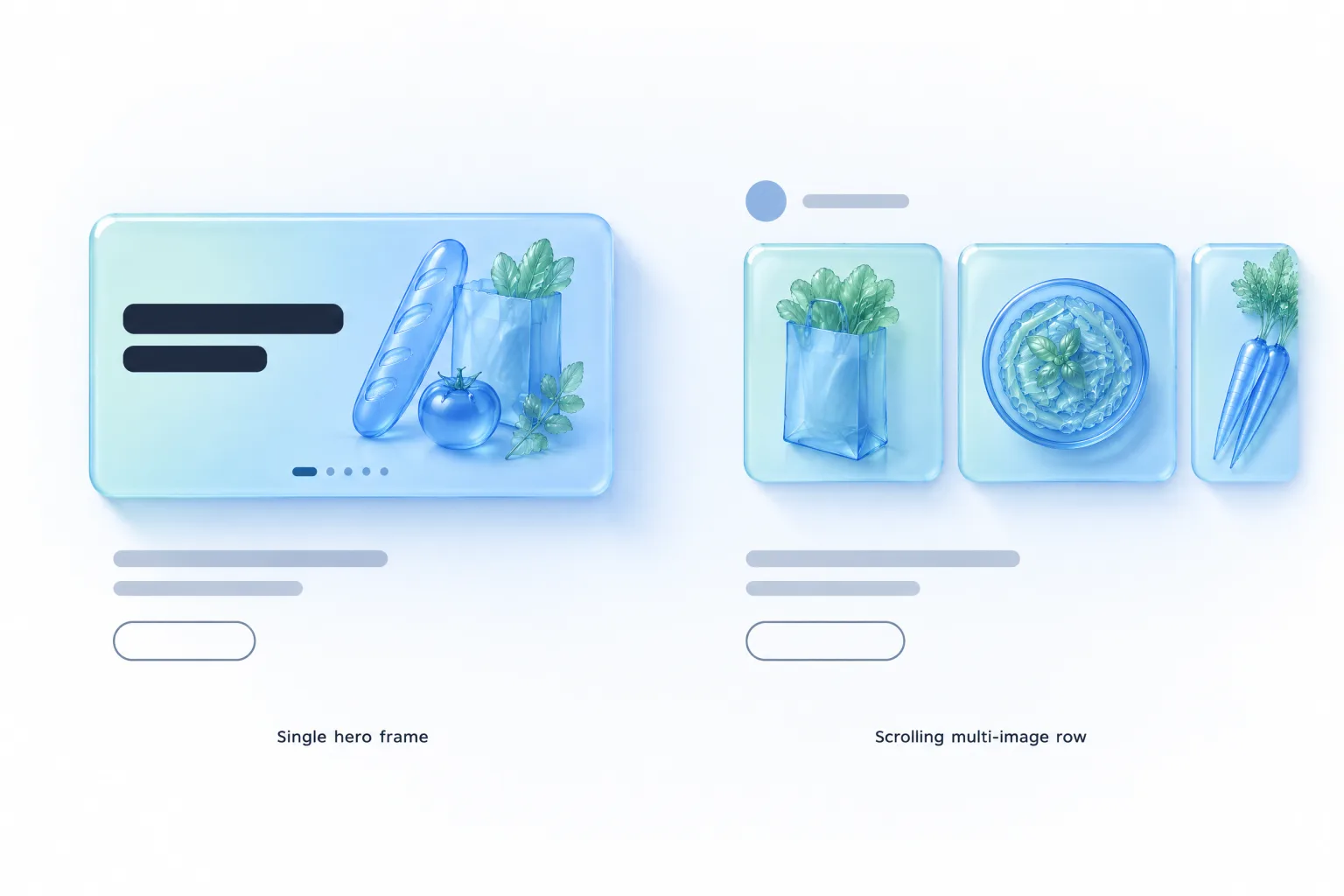
Whether both layouts will ship, whether advertisers choose between them, or whether the system picks one, is not stated. The practical lesson holds either way. Build creative that works in both shapes. That means a wide frame that can carry a short line of type, plus a set of square frames that work with no type at all. I set out a full creative kit for that below.
What the mockup's creative choices teach
OpenAI chose a fictional grocery brand for its demo, and the creative choices are worth copying even before the specs arrive:
- No logo-led creative. No frame is a logo on a plain background. The brand appears as a name and a letter badge. The imagery is all product and outcome. That matches OpenAI's long-standing advice for the standard unit not to lead with your logo.
- Consistent background colour. Every image shares a soft green palette. In the scrolling row that consistency makes three separate photos read as one ad.
- Outcome, not inventory. The middle tile is a finished dish, not a product. It shows what the groceries become. That is the “experiences a product makes possible” idea in practice.
- Matching message. The image headline (“Fresh ideas for dinner”) and the text headline (“Fresh Groceries for Easy Weeknight Dinners”) say the same thing two ways. One is a mood, the other is a promise.
Why image generation is the first placement
Putting the first visual ads inside image generation, rather than under text answers, is a deliberate choice. Here is why I think it makes sense for OpenAI, and what it means for advertisers.
The waiting moment
Image generation is one of the few times in ChatGPT when the user has nothing to read. A text answer streams in and the user reads as it arrives. An image arrives as a progress bar, then a slowly sharpening picture. Their eyes are on the screen and their mind is already on visual things. That is the same logic as the video pre-roll or the loading-screen ad, with one difference: the user chose to be here and the wait is short. An ad in that window competes with almost nothing. It does not compete with the answer, because the answer is not ready yet.
Intent signals are richer than they look
People generate images for reasons. They redesign a living room, mock up a birthday invitation, try a haircut idea, picture a garden layout, make a product photo for an online shop, plan an outfit, or visualise a trip. Each of those prompts states a project, often with a style, a budget level and a timeline. Someone asking for “a Scandinavian living room with a green velvet sofa and warm oak floors” is further down the buying path than most search queries. They have chosen the style and are now seeing what it looks like.
OpenAI hasn't said how visual ads will be matched to image prompts. The standard ChatGPT ad matches on conversational context, which advertisers steer with context hints. It is reasonable to expect relevance in the image placement to depend on what the user is creating, but that is my inference. Wait for OpenAI to confirm the targeting before you build hint lists for it.
Visual ads belong in a visual moment
A text answer is a poor home for an image-heavy ad. The reader is reading, and a big picture breaks the flow and feels intrusive. An image-generation session is the opposite. The user wants pictures, and a well-made product image fits the moment. The same image under a text answer about tax deadlines would feel jarring. That fit is likely why OpenAI tested here first.
The commercial logic
OpenAI says plainly that advertising lets it serve a much larger market than subscriptions alone, and that broad access is central to its mission. Image generation is expensive to serve and popular with free users. Pairing an expensive, popular free feature with a format that only that feature can host is a sensible business decision, and OpenAI has not hidden it. For advertisers the effect is simple: OpenAI wants this placement to work and will likely put real product effort behind it.
What is confirmed, and what is not yet published
Before you plan budget, separate what OpenAI has said from what people are guessing. This table is the core of the guide. I will update it as OpenAI publishes more.
| Question | Status | What we know |
|---|---|---|
| Does the format exist? | Confirmed | Announced 15 October 2026 as a new visual ad format |
| Where does it run first? | Confirmed | During image generation in ChatGPT |
| Which users? | Confirmed | Free and Go plans |
| Which market? | Confirmed | US, for the initial test |
| When? | Confirmed | Testing begins “later this month” (October 2026) |
| Who can buy it? | Partly confirmed | “An initial group of advertisers”; selection criteria not published |
| Labelling | Confirmed | Clearly labelled; exact label wording not confirmed |
| Separation from output | Confirmed | Remains separate from the image being created |
| Influence on answers | Confirmed | Advertising does not influence ChatGPT's answers |
| Image dimensions and count | Not published | Mockup suggests a wide frame and square frames, about five frames per sequence |
| Text in images allowed? | Not published | Mockup shows headline type inside one frame |
| Headline and CTA rules | Not published | Mockup shows a 42-character headline and a “Learn more” button |
| Pricing and bidding | Not published | Standard units buy on CPM, CPC or oCPC; no word on the visual format |
| Targeting | Not published | No statement on how ads match image prompts |
| Reporting metrics | Not published | No statement on per-frame or per-tile metrics |
| Video | Not announced | The announcement covers images only |
| Other placements | Not announced | Image generation is described as the “initial” test surface |
| Other markets | Not announced | US only at first |
One line in the measurement blog hints at what comes next. OpenAI says its brand-lift testing with Kantar and Cint is happening “as we begin experimenting with new placements.” Read with the visual announcement, that suggests OpenAI expects visual placements to be judged partly on brand outcomes (awareness, consideration, preference) and not only on clicks and conversions. If you are a brand advertiser, plan to prove value that way too.
How the visual format compares with existing ChatGPT ad units
Advertisers will soon have three kinds of ChatGPT inventory: the standard sponsored unit, product feed ads (including the multi-product carousel), and the visual format. Each has a different job, a different source of creative and a different measurement profile. Treating them as interchangeable is the fastest way to waste a test budget.
| Dimension | Standard sponsored unit | Product feed ads and carousel | Visual format (testing) |
|---|---|---|---|
| Where it appears | Beneath a ChatGPT text response | In shopping-oriented conversations, as single products or a multi-product carousel | During image generation, below the image being created |
| Creative source | Advertiser-written headline, description and a small square image | Generated from the product catalog feed | Advertiser-supplied imagery (exact specs unpublished) |
| What the image does | Recognition: a thumbnail that helps place the brand | Shows the specific product | Carries the message: inspiration, usage or experience |
| Matching | Conversation context, steered by context hints | Conversation context plus feed attributes | Not published |
| Buying models | CPM (Reach), CPC (Clicks), oCPC (Conversions) | Click-based buying, with oCPC in beta for feed campaigns since August 2026 | Not published |
| Funnel position | Mid to lower funnel, at the decision moment | Lower funnel, product choice | Upper to mid funnel, while a project is being planned |
| Primary metric | Cost per conversion | ROAS, cost per purchase | Likely brand lift plus view-through and incremental conversions |
| Markets | More than a dozen markets | See OpenAI's feed documentation per market | US only, initially |
| Availability | Self-serve, no minimum spend since 5 May 2026 | Self-serve with a connected feed | Initial advertiser group only |
When to use which
The three formats map to three questions a user is asking:
- “Which option should I choose?” This is a text conversation weighing alternatives. The standard unit, matched by well-written context hints, is built for it.
- “Which product, exactly?” This is a shopping conversation about specific items. Product feed ads put catalog items in front of the user with prices and attributes.
- “What could this look like?” The user is creating an image of a project, room, outfit, trip or event. The visual format meets them while they imagine the result.
Most consumer brands will eventually want all three, with budgets set by role rather than by format. A reasonable starting split for a consumer brand already spending on ChatGPT, once the visual format is generally available, might put most budget in standard and feed units, where outcomes are measurable now, and a fixed test allocation in visual until incrementality and brand-lift evidence justify more. That is a planning heuristic, not an OpenAI recommendation, and the right split depends on what your own measurement shows.
Overlap risk
One question OpenAI hasn't answered is whether one advertiser can appear in more than one format in the same session. For example, a visual ad during image generation, then a standard unit when the user asks a follow-up question in text. If it can, frequency across formats becomes something to manage. If it can't, the formats compete for your budget only, not for the same user's attention. Until it is documented, check your reporting for users exposed to both, and don't assume conversions credited to one format weren't helped by the other.
Which advertisers the visual format fits
Two things set the limits on who can use visual ads. The first is policy: which categories ChatGPT accepts at all. The second is context: which products make sense next to someone generating an image. Start with policy, because it rules some advertisers out entirely.
The category filter
OpenAI's ad policies, last updated 10 September 2026, say that during the early phases ads are mainly limited to consumer categories: household and consumer goods, local services, travel and entertainment, and digital products and education. Financial services, healthcare and legal services can be approved case by case, mostly in the US, with manual review. A long list of categories is disallowed outright, including alcohol, gambling, adult content, recreational drugs, political content and weight-loss-style wellness claims. These standards apply to all ad assets, including copy, images or video, and landing pages. In a visual format, the image itself gets reviewed against the same rules as everything else.
So the visual format starts life as a consumer format. That suits it. The categories ChatGPT already prefers are the ones where imagery carries the sale: furniture, fashion, food, travel, home improvement, consumer tech, hobbies, courses with a visible outcome.
The context filter: what people generate images of
The more interesting question is which image-generation sessions suit which advertisers. OpenAI hasn't published targeting for the visual format, so the table below is a planning map, not a buying menu. It sets out common reasons people generate images and the advertisers whose products fit next to them.
| What the user is generating | What it says about them | Natural advertiser fit | Image job that fits best |
|---|---|---|---|
| A room redesign, a colour scheme, a furniture layout | Planning a home project, style partly chosen | Furniture, paint, flooring, lighting, home services | Usage: the product in a finished room |
| An outfit, a hairstyle, a look for an event | Planning an appearance, often date-bound | Fashion, accessories, salons, beauty retail | Inspiration: styled looks |
| A travel scene, an itinerary visual, a destination mood board | Dreaming about or planning a trip | Hotels, tours, airlines, luggage, travel gear | Experience: the moment at the destination |
| A party invitation, a birthday theme, a wedding mood board | Event planning with a fixed date | Venues, catering, decorations, printing, gifts | Experience: the event as it could look |
| A garden plan, a patio, a landscaping idea | Outdoor home project, seasonal timing | Garden centres, outdoor furniture, landscaping services | Usage: the space after the work |
| A recipe illustration, a meal-plan visual | Cooking intent, often for this week | Grocery delivery, meal kits, cookware | Inspiration to usage: ingredients becoming the dish |
| Product photos, a logo, a shop banner | Running or starting a small business | E-commerce platforms, print-on-demand, design tools, business services | Usage: the tool producing a result |
| Diagrams, slides, study visuals | Learning or presenting | Courses, education platforms, presentation software | Experience: the outcome of the skill |
| Fitness visuals, a home-gym layout | Health-adjacent planning | Fitness equipment, workout programmes (no medical claims) | Usage: equipment in a real space |
| Pet portraits, pet product ideas | Pet owner, emotionally engaged | Pet supplies, pet services | Experience: life with the pet |
Two warnings about this table. First, some image sessions involve exactly the sensitive contexts where OpenAI's guardrails block ads: personal health, grief, intimate subjects, political imagery, anything involving minors. Expect a meaningful share of image sessions to be ineligible, and don't assume the reach of the whole image-generation audience. Second, fit is not the same as permission to target. Until OpenAI says how matching works in this placement, the table tells you whether your brand belongs in the format, not how to buy it.
Who should wait
Some advertisers should let others go first:
- B2B software with no visual outcome. If the honest image of your product is a dashboard, the format will struggle to show inspiration, usage or experience. The standard text unit and organic visibility are better first investments.
- Regulated categories. Finance, health and legal advertisers already need case-by-case approval. A new format in a test phase adds review risk with little upside.
- Brands without first-party image rights. If your best images are licensed for limited use, or are user-generated photos you never cleared for paid media, sort out rights before the format arrives. Paid use in a new channel often isn't covered by old licences.
- Accounts without working conversion tracking. A visual format will be judged on outcomes. If your pixel and Conversions API aren't solid on the standard unit, fix that first. Otherwise you will be testing a new format with no way to read the result.
Creative strategy: the three jobs an image can do
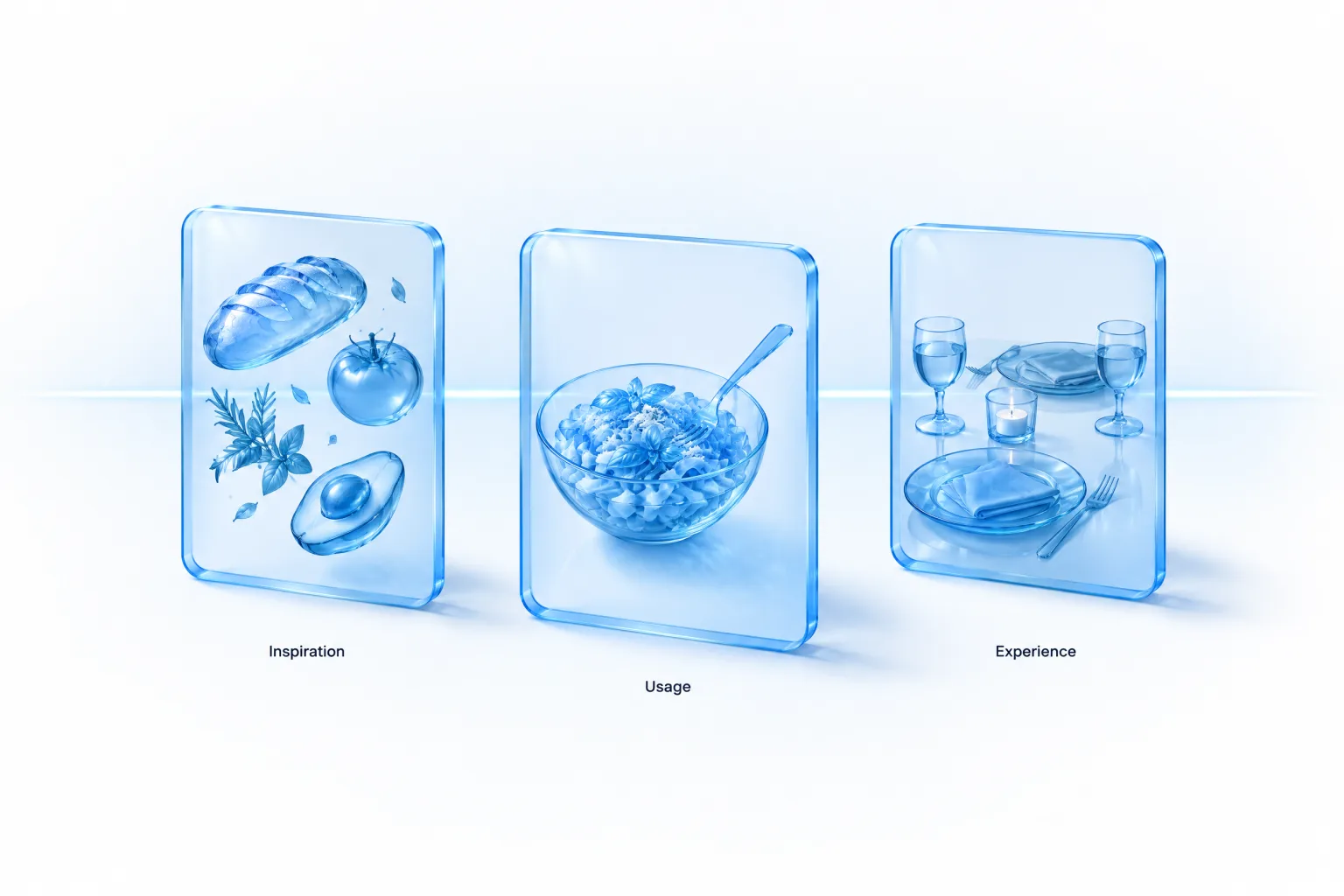
OpenAI's own description gives you the creative framework. Images can show product inspiration, product usage, or the experiences a product makes possible. Those are three different jobs, and a good visual ad sequence usually uses at least two of them.
Job one: inspiration
Inspiration images show possibility. They answer “what could I do with this?” before the user has decided to do anything. In OpenAI's mockup, the hero frame (loose ingredients, a bag, fresh produce, “Fresh ideas for dinner”) is an inspiration image. It doesn't show a recipe or a delivery. It suggests that dinner could be good.
Inspiration works best near the top of a sequence and when the user's image session is exploratory. Someone generating “cosy autumn living room ideas” is browsing, not buying, and an inspiration image meets them there. Good inspiration images share a few traits:
- Variety within one style. Several items or ideas, arranged with care, in one colour story.
- Space to imagine. Not too finished. The viewer should be able to picture their own version.
- Seasonal or moment cues that match when the ad runs, such as autumn light, holiday table settings or summer produce.
Job two: usage
Usage images show the product doing its job. They answer “what does it look like when I use it?” The middle tile in OpenAI's scrolling row, a finished pesto pasta, is a usage image: the groceries have become dinner. For a sofa, usage is the sofa in a lived-in room. For a course, it is the thing the student can now make. For a travel bag, it is the bag packed at a hotel door.
Usage is the most persuasive of the three for considered purchases, because it shrinks the gap between the product and the user's own situation. It is also where most brands' existing creative is weakest. Catalog shots on white backgrounds show the product, not the product in use. If you have to build one new kind of image for this format, build usage images.
Job three: experience
Experience images show the moment the product makes possible, often with the product barely visible. A meal-kit brand shows a table set for friends. A hotel shows a balcony at sunrise. A language course shows a café menu in another country. These images sell the result, not the means.
Experience images are powerful but easy to get wrong. If the product isn't recognisable, the viewer remembers the mood and forgets the brand. Fix that with consistency: the same colour palette, setting or styling across every frame, so the experience frame clearly belongs to the same advertiser as the product frames around it.
Sequencing the three
If the format supports multiple frames, as both layouts in the mockup suggest, order matters. My default for a five-frame sequence:
- Inspiration, to catch attention. The widest, most striking frame, possibly with a short line of type if the format allows it.
- Usage, the product in its natural setting.
- Usage, a second angle: a detail, a variant or a second use case.
- Experience, the moment it makes possible.
- Proof or offer: a clean product shot with a simple visual cue of the offer, if the rules allow type. Otherwise, the most recognisable product image.
On the scrolling row, the first two tiles are probably the only ones most people see without scrolling, so they must carry the message alone. Lead with your strongest usage image, not your logo or a lifestyle shot where the product is hard to spot.
The rule most visual advertisers will break: interface imitation
One line in OpenAI's ad policies matters far more in this format than in any other. Under baseline standards, “Interface imitation” says ads must be clearly distinguishable from the ChatGPT product experience. OpenAI may remove or require changes to ads that imitate the appearance, functionality or voice of ChatGPT or other OpenAI interfaces in a way that could make users think the ad is part of the product.
In a text answer, imitation means copying ChatGPT's tone or layout. In image generation it is much easier to break the rule by accident. The product's output is an image. An ad image that looks like an AI-generated image the user might have asked for (the same soft render, the same composition, a subject that matches the prompt) risks being read as part of the generated result. That is exactly the confusion OpenAI's separation commitment is meant to prevent, so I expect reviewers to watch for it.
In practice:
- Don't mimic the generation look. Avoid creative that copies the progressive render, the halftone loading pattern, or framing that looks like a ChatGPT output canvas.
- Don't write copy as if ChatGPT made the image for the user. Lines like “Here's your dinner idea” or “Your room, reimagined” sound like the assistant answering. Speak as the brand.
- Prefer real photography or obviously branded art direction. A consistent brand palette, real products and recognisable styling make it clear the image comes from an advertiser.
- Be careful with AI-generated ad creative. Nothing in the published policy bans AI-made ad images, and many brands now produce creative with image models. But an AI image placed next to an AI image is where confusion is most likely. If you use generative creative, art-direct it so it looks like your brand, not like a default model output.
This is my reading of how the existing policy applies to the new placement, not a published OpenAI rule for visual ads. It is the creative risk I would design around from day one.
What the ad policies say about images
Beyond interface imitation, several published rules apply directly to image creative. All of them come from OpenAI's ad policies as updated 10 September 2026:
| Policy area | What it says that affects imagery | What to do |
|---|---|---|
| End-to-end consistency | Standards apply to copy, images or video and landing pages; approved creative may not link to destinations with disallowed content | Check that every frame and the landing page pass the same category rules |
| Alcohol | Alcohol ads disallowed; incidental references acceptable only when alcohol is not the focus | A wine glass in a dinner scene may pass; a bottle as the hero will not. Keep it peripheral or remove it |
| Adult content | No sexualised poses or explicit or racy imagery; lingerie and swimwear allowed in a standard retail context | Shoot apparel in neutral, catalog-style poses |
| Graphic content | No graphic or realistic violence; stylised or cartoon violence without gore may be allowed | Relevant for games and entertainment; avoid shock frames |
| Misleading claims | No exaggerated results, false endorsements or deceptive comparisons | Before-and-after images need to be truthful; don't imply endorsements you don't have |
| Offensive content | Professional, non-offensive language and imagery, including in product names | Check brand names and on-image type |
| Wellness claims | No unsubstantiated health claims; general wellness allowed without medical claims | Fitness imagery is fine; transformation-body imagery with implied results is risky |
| Sensitive topics | No exploiting contested social issues or tragedies | Avoid newsjacking imagery |
| Intellectual property | Only use trademarks, logos and assets you own or are authorised to use | Clear rights for every product, prop and location in the frame |
The alcohol rule shows how much harder review gets with images. A text ad for a dinner-party venue never mentions wine. A photo of the same dinner party almost always has wine glasses on the table. Under the published rule, incidental alcohol can pass when alcohol isn't the focus. That is a judgement call a reviewer will make on your frame, so remove the ambiguity before you upload.
Building a visual creative kit before the specs arrive
You can't upload to a format with no published spec. You can build the assets now so you are ready the day access opens. Production takes weeks, while setting up a campaign takes an afternoon. The brands that do well early in a new format are the ones who had creative ready.
The kit
Based on the two layouts in OpenAI's mockup, I'd prepare each concept like this:
| Asset | Shape | Count per concept | Notes |
|---|---|---|---|
| Hero frames | Wide landscape, with clear space on one side | 1–2 | Leave room for a short headline in case the format allows type. Keep the subject on the other side |
| Square tiles | 1:1 | 4–6 | Must work with no type. Shared background colour or setting across the set |
| Type-free hero variant | Wide landscape | 1 | The same hero with no type, in case on-image text is not allowed |
| Masters | Full-resolution source files | All | Keep layered files so crops can be made fast when specs arrive |
| Headlines | Text | 3–5 variants | One short (under 30 characters) and one longer (around 40), since the mockup shows a 42-character line |
| Alt descriptions | Text | One per image | Useful for accessibility if supported, and for your own creative library |
Shoot with safe margins. When a new format's specs arrive, the surprise is almost always the crop. A square tile in a carousel may be shown with rounded corners, overlaid controls or a badge. Keep the product inside the central 70 to 80 per cent of each frame and you can adapt to almost any spec.
Concept discipline
Build one concept per audience moment, not one concept per product. A furniture retailer doesn't need a visual ad for every sofa. It needs one concept for “redesigning the living room”, one for “furnishing a first apartment” and one for “hosting season”, each matched to the image-generation sessions where those moments happen. That fits how relevance works on ChatGPT generally. Context, not catalog, decides whether an ad belongs in a conversation. I cover that logic in depth in context hints versus keywords.
Three worked concepts
These are illustrative examples I built for this guide, not real campaigns. They show how the three-job framework turns into a frame list.
Concept A: a home-furnishings retailer, “first apartment” moment.
- Frame 1 (inspiration, wide): a bright, half-furnished studio apartment with three hero pieces arranged in it. Space on the left for “Make it yours from day one.”
- Frame 2 (usage, square): the sofa bed folded out, with linen made up.
- Frame 3 (usage, square): the storage ottoman open, showing folded blankets.
- Frame 4 (experience, square): two mugs on a small table by a window in the evening. Furniture visible, no people.
- Frame 5 (proof, square): the three pieces on the brand's signature background colour.
- Headline: “Small-Space Furniture That Works Twice as Hard” (46 characters), with a short alternative: “Furniture for Small Spaces” (26).
Concept B: a tour operator, “planning a trip” moment.
- Frame 1 (experience, wide): a coastal path at golden hour, a small group's backpacks resting on a stone wall, no faces.
- Frame 2 (usage, square): the guesthouse room the tour uses, made up and sunlit.
- Frame 3 (usage, square): a local lunch spread at one of the stops.
- Frame 4 (inspiration, square): a hand-drawn-style route map in brand colours.
- Frame 5 (proof, square): the brand's guide vehicle or welcome pack, clearly branded.
- Headline: “Small-Group Coastal Walks, Bags Carried for You” (47 characters). The short version: “Coastal Walking Tours” (21).
Concept C: an online design course, “making things for my small business” moment.
- Frame 1 (experience, wide): a finished, well-designed shop window display, the kind of result the course promises.
- Frame 2 (usage, square): a laptop showing a clean course lesson screen. Generic interface only, nothing that looks like ChatGPT.
- Frame 3 (usage, square): printed packaging a student designed.
- Frame 4 (inspiration, square): a colour-palette swatch board.
- Frame 5 (proof, square): the course's own brand mark on its signature colour.
- Headline: “Design Your Own Packaging in Four Weeks” (39 characters). The four-week claim must be true of the course.
Notice what is missing from all three: logo-first frames, stock photos of smiling people, and any frame that could be mistaken for the user's own generated image.
A copyable creative brief
This is the brief I'd hand a photographer or design team today. Fill in each field.
VISUAL AD CONCEPT BRIEF — ChatGPT visual format (pre-spec)

Concept name:
Audience moment (what is the user creating?):
Single message (one sentence):
Category check (allowed under OpenAI ad policies? any restricted items in frame?):

FRAMES
 1. Wide hero  — job: inspiration | subject: | clear-space side: L / R
 2. Square     — job: usage       | subject:
 3. Square     — job: usage       | subject:
 4. Square     — job: experience  | subject:
 5. Square     — job: proof       | subject:
 Shared art direction (palette / setting / light):
 Safe zone: product inside central 75% of every frame

COPY
 Headline long (~40 chars):
 Headline short (<30 chars):
 On-image line (only if format allows, <6 words):

COMPLIANCE
 Interface imitation check — could any frame be mistaken for a ChatGPT-generated image? Y/N
 Alcohol / adult / wellness / IP check per frame:
 Landing page matches message and passes same policy:

MEASUREMENT
 Primary KPI:
 Secondary KPI (brand / view-through / incrementality):
 Landing page URL with tracking parameters:
Landing pages built for visual ads
The visual format raises the bar for landing pages in a way that is easy to miss. A text ad sets an expectation in words. A visual ad sets it in images. When a user taps “Learn more” on a frame showing a finished, sunlit living room, they expect to land somewhere that looks like that room, not on a generic category page of product thumbnails. The gap between the image and the page is where visual campaigns lose most of their conversions.
Continue the image
The first screen of the landing page should show the same scene, or the same art direction, as the frame the user tapped. If you have five frames and one landing page, open the page with the hero frame's scene and make sure the products in every frame are visible above the fold or one scroll down. Where the platform's dynamic URL parameters let you pass the ad ID, you can go further and show a hero image that matches the specific creative. That is a modest build for a large gain in continuity.
Design for the phone the user is holding
OpenAI's mockup shows phone screens, and image generation on the move is a heavily mobile behaviour. Visual-ad landing pages should be built mobile-first:
- Fast first image. Compress the hero, serve modern formats and preload it. A slow-loading hero image after an image-led ad feels like a broken promise.
- Shoppable within one scroll. Price, the main product and an add-to-basket or enquiry action should be reachable without hunting.
- No interstitials. Email pop-ups that cover the image the user came to see undo the work of the ad.
- Readable copy at phone size. Any text in the hero must be legible on a small screen, not just on the designer's monitor.
Keep it reviewable and compliant
OpenAI's ad policies say ads or landing pages its systems can't review or evaluate aren't allowed to run. Pages that hide their main content behind heavy client-side scripts, geo-block review systems, or require a login can fail review for that reason alone. The same end-to-end rule applies as for the image. A page linked from a compliant visual ad must not introduce disallowed content, such as an alcohol upsell on a dinner-party bundle page.
Measure the page, not just the ad
Make sure the landing page fires the pixel's page-view and key events, that Conversions API events deduplicate against them, and that your analytics records the ChatGPT parameters on arrival. For view-through-heavy formats, also watch direct and branded-search sessions to the same landing page in the hour after exposure windows. That is the behaviour OpenAI's first-hour analysis implies, and your analytics will only see it if you look for it.
Using AI image tools to make your ad creative
Many advertisers will make visual-ad creative with image models, including ChatGPT's own. Nothing in OpenAI's published ad policies bans AI-generated ad imagery. The policy standards apply to the content of the image, not to how it was made. But producing AI creative for a placement that sits next to AI-generated images needs some care.
- Accuracy first. An AI image of your product must show the product as it really is: the right colours, proportions, materials and included parts. A generated sofa that is deeper, plusher or a different shade than the one you ship is a misleading-claims problem and a returns problem.
- Art-direct away from the default look. Model outputs share recognisable traits: very smooth surfaces, perfect symmetry, certain lighting habits. Use your brand's real palette, real props and styling references so the image reads as your brand, not as a generic render that could pass for the user's own output.
- Composite real products into generated scenes when you can. A real product photograph placed into a generated or styled setting keeps the product accurate while letting you produce many scenes cheaply.
- Check rights and model terms. Confirm your image tool's terms allow commercial advertising use, and don't prompt for other brands' trademarks, distinctive designs or recognisable people.
- Keep a provenance record. Note which frames are generated, which are photographed and which are composites. If a reviewer or a regulator ever asks, you'll have the answer.
A note on this guide's own images: they're AI-generated illustrations in the Context Hints house style, made to explain concepts. None of them is a screenshot of ChatGPT or a real advertiser's ad.
Accessibility and inclusive imagery
Image-led advertising raises accessibility questions text ads never had to answer. OpenAI hasn't said whether the visual format supports alt text or other assistive features. Plan for good practice anyway:
- Don't put essential information only in the image. If the offer is in the picture, repeat it in the headline. Users with screen readers or images turned off should still get the message.
- Write a plain description for every frame and store it with the asset, ready for any alt-text field the format adds.
- Check contrast on any on-image type. A pale headline on a pale-mint background, like the style of OpenAI's mockup, needs strong enough contrast to read on a phone in daylight.
- Represent your real customers. Where your imagery shows homes, settings or, in time, people, make sure it reflects the range of customers you serve. Generic, narrow imagery is a missed connection for many of the people the ad reaches.
Measuring ChatGPT Ads: the expanded partner ecosystem
OpenAI says its measurement approach for ChatGPT Ads supports both in-house and partner-led measurement. You can measure with OpenAI's own tools (the pixel, the Conversions API, Ads Manager reporting) or with the third-party systems you already trust. The measurement blog names four layers that approach covers: signals via Pixel and Conversions API, attribution, incrementality, and brand measurement. It calls this its “first set of third-party partners” across those layers.
That four-layer structure is the most useful way to read the announcement, because each layer answers a different question:
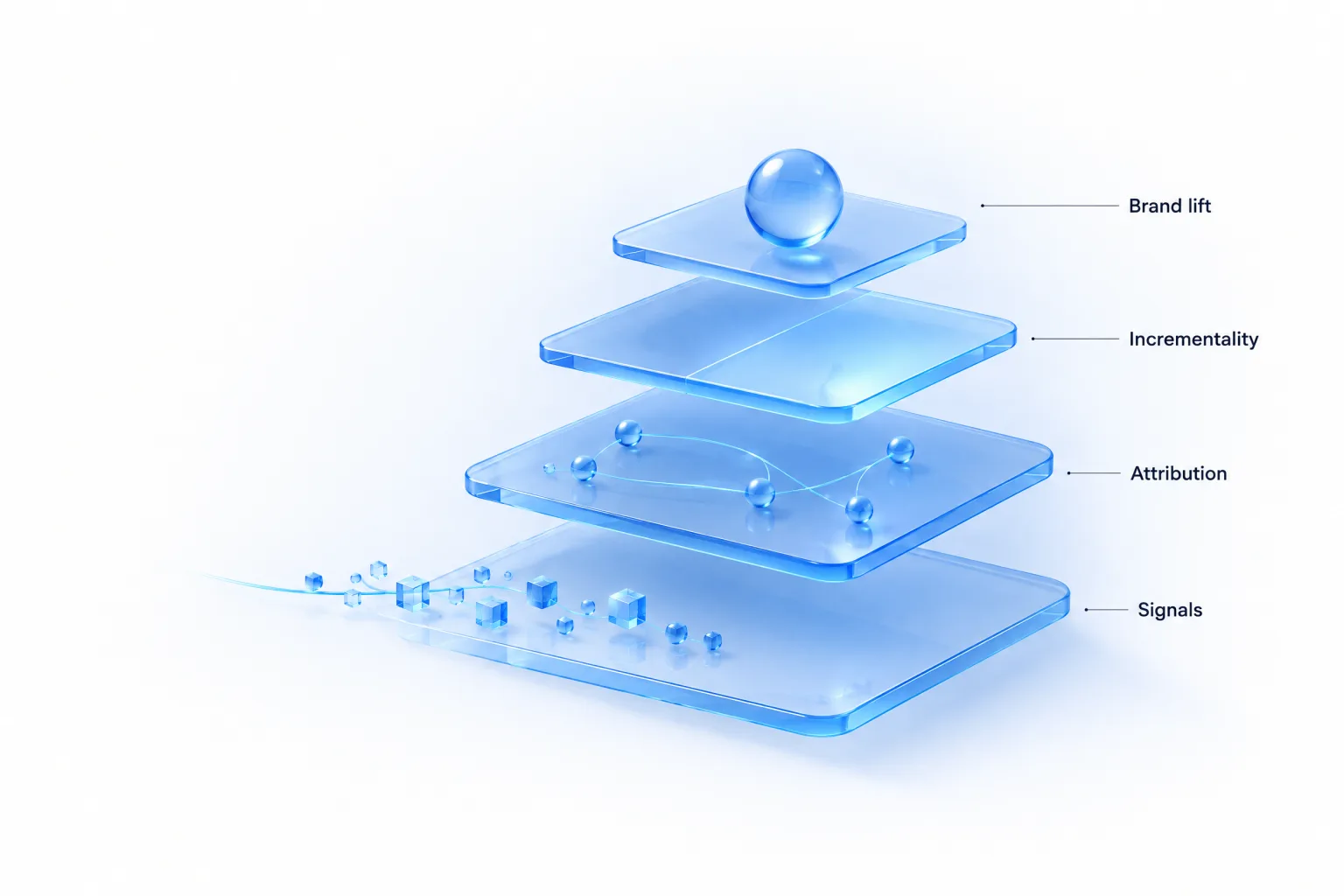
| Layer | Question it answers | Named partners | Who needs it |
|---|---|---|---|
| Signals | Did the conversion data reach ChatGPT Ads, complete and matched? | Hightouch, Tealium, LiveRamp (plus OpenAI's own pixel and Conversions API) | Every advertiser optimising for conversions |
| Attribution | Which conversions followed an ad interaction, by the rules I chose? | AppsFlyer, Triple Whale, Adjust, DV Rockerbox, Northbeam, Branch, Singular, Kochava, Airbridge, Tenjin | Anyone reporting performance across channels |
| Full-funnel and advanced | How does ChatGPT contribute alongside every other channel? | Fospha, Measured, INCRMNTAL | Multi-channel advertisers using media-mix or always-on incrementality |
| Incrementality | Would these conversions have happened without the ads? | Haus, Measured, WorkMagic (geo-based experiments, early stage) | Advertisers with enough budget to run a powered test |
| Brand | Did the ads change awareness, consideration or preference? | Kantar, Cint (early-stage testing) | Brand-led advertisers, and new placements |
This guide covers what the announcement changes for each layer. For a deeper treatment of the earlier partner integrations (Hightouch's Conversions API destination, Triple Whale's reporting, Sonar Optimize and the pixel diagnostics panel), see ChatGPT Ads measurement partners. For the base implementation of pixel and server events, see ChatGPT Ads conversion tracking.
Layer one: signals, and getting conversion data in
Everything above depends on this layer. OpenAI says its pixel and Conversions API help advertisers measure actions such as purchases, leads, installs and sign-ups, and use those signals to optimise campaigns. The new part of the announcement is three integrations that make it easier to send conversion data from systems advertisers already run: Hightouch, Tealium and LiveRamp.
What each integration is for
OpenAI hasn't published integration-level detail for all three in this announcement, so here is what each kind of platform usually does in an ad-measurement stack, and so which advertisers each route suits:
| Partner | Type of platform | Typical route | Best fit |
|---|---|---|---|
| Hightouch | Composable CDP / reverse ETL | Conversion events modelled in your data warehouse, synced to ChatGPT Ads | Teams with Snowflake, BigQuery or Databricks as the source of truth, including offline and CRM conversions |
| Tealium | Tag management and customer data platform | Events collected in Tealium's client-side and server-side streams, forwarded to ChatGPT Ads | Enterprises that already route marketing tags and events through Tealium |
| LiveRamp | Identity resolution and data collaboration | Conversion data linked through LiveRamp's identity infrastructure | Large advertisers and retailers with identity-graph and clean-room programmes |
The decision is simpler than the vendor list suggests. Use the system your conversion data already lives in. If your conversions are modelled in a warehouse, a warehouse-native route (Hightouch) avoids building a second pipeline. If your company runs on Tealium, use the Tealium connector rather than hand-coding a parallel server integration. If you are an enterprise already using LiveRamp, the identity-linked route is likely the one your data governance team will approve fastest. If none of these apply, OpenAI's own pixel plus a direct Conversions API build, or a partner like those covered in our partner guide, is still a complete answer.
Signal quality comes before signal volume
The measurement blog makes a point that is easy to skim past: getting the most from these tools starts with good conversion signals. OpenAI points to Event Quality Score (EQS) as the way to judge the quality of the signals you send and find ways to improve them. Better signals give OpenAI's measurement and optimisation systems better information to work with. We have a full guide to ChatGPT Ads Event Quality Score, and the practical rules carry straight over:
- Send both browser and server events, deduplicated. A new pipeline through Hightouch or Tealium must use the same event IDs as the pixel, or conversions will count twice.
- Send more matching fields. The Conversions API accepts several hashed identifiers per event. Richer payloads mean more conversions match to the ads that drove them. Automatic Advanced Matching handles part of this for the pixel.
- Send values, currency and stable IDs. Without them, value-based optimisation and partner reconciliation both break.
- Watch latency. Batch warehouse syncs that send conversions a day late weaken optimisation, especially now that view-through conversions feed optimisation (more on that below).
Moving to a new integration is the most common way a working setup breaks. If you switch routes, run the old and new pipelines in parallel for at least a week, compare counts by event name, and only then turn off the old one.
Layer two: attribution partners for web and app
OpenAI says it now supports leading attribution partners across web and app, enabling Conversions API, reporting and click attribution with ten named companies. The list combines two groups of vendors that solve different problems, and you should treat them separately.
Mobile measurement partners (app advertisers)
AppsFlyer, Adjust, Branch, Singular, Kochava, Airbridge and Tenjin are mobile measurement partners (MMPs). They are the systems app advertisers use to attribute installs and in-app events across ad networks, and to deal with platform privacy rules on mobile. Support here matters most for app-install and app-engagement advertisers, who until now had trouble putting ChatGPT Ads alongside their other networks in the one attribution system finance trusts.
If you are an app advertiser, the work is:
- Check with your MMP how ChatGPT Ads appears as a media source and what setup it needs on their side.
- Confirm which events flow back to ChatGPT Ads for optimisation, and that in-app purchase values and currency come through.
- Line up your MMP's attribution window with what you have chosen in Ads Manager, or record the difference so reporting gaps are explained, not argued about.
- Decide which system is the source of truth for budget decisions. Usually it is the MMP for apps. Ads Manager reporting then becomes a diagnostic view.
Web and ecommerce attribution platforms
Triple Whale, Northbeam and DV Rockerbox are web-focused, multi-touch attribution and analytics platforms, popular with direct-to-consumer and ecommerce brands. They pull ad platform data together with store data to show cross-channel performance, often with their own attribution models. Support here means a ChatGPT Ads spend line can sit in the same dashboard as Meta, Google and TikTok, judged by the same model.
This matters more than it sounds. In my experience, new channels lose budget fights not because they perform badly but because they are measured in a different system from the incumbents. A channel reported only in its own dashboard is always suspected of grading its own homework. Putting ChatGPT in the same MTA view as everything else removes that objection, for better or worse.
Full-funnel and advanced partners
Fospha, Measured and INCRMNTAL are named as full-funnel and advanced measurement partners. They work above click-level attribution: media-mix modelling, always-on incrementality, and models that credit channels for effects click tracking misses. Measured also appears in the incrementality group below. These partners matter most for advertisers whose budget decisions already run on modelled measurement rather than last-click.
Choosing an attribution route
| If you are… | Start with | Why |
|---|---|---|
| An app-first business | Your existing MMP | Install and in-app attribution belongs in one system across all networks |
| A Shopify-scale DTC brand | Your existing MTA tool (Triple Whale, Northbeam or DV Rockerbox) | Same model and dashboard as your other paid channels |
| A multi-channel brand on MMM | Fospha, Measured or INCRMNTAL if already contracted | Puts ChatGPT inside the model that already sets your budgets |
| A small advertiser with none of these | OpenAI's pixel, Conversions API and Ads Manager reporting, plus UTMs in GA4 | Adding an attribution vendor for one new channel rarely pays back; use dynamic URL parameters to tie clicks to your analytics |
Beyond the click: view-through conversions and the first hour
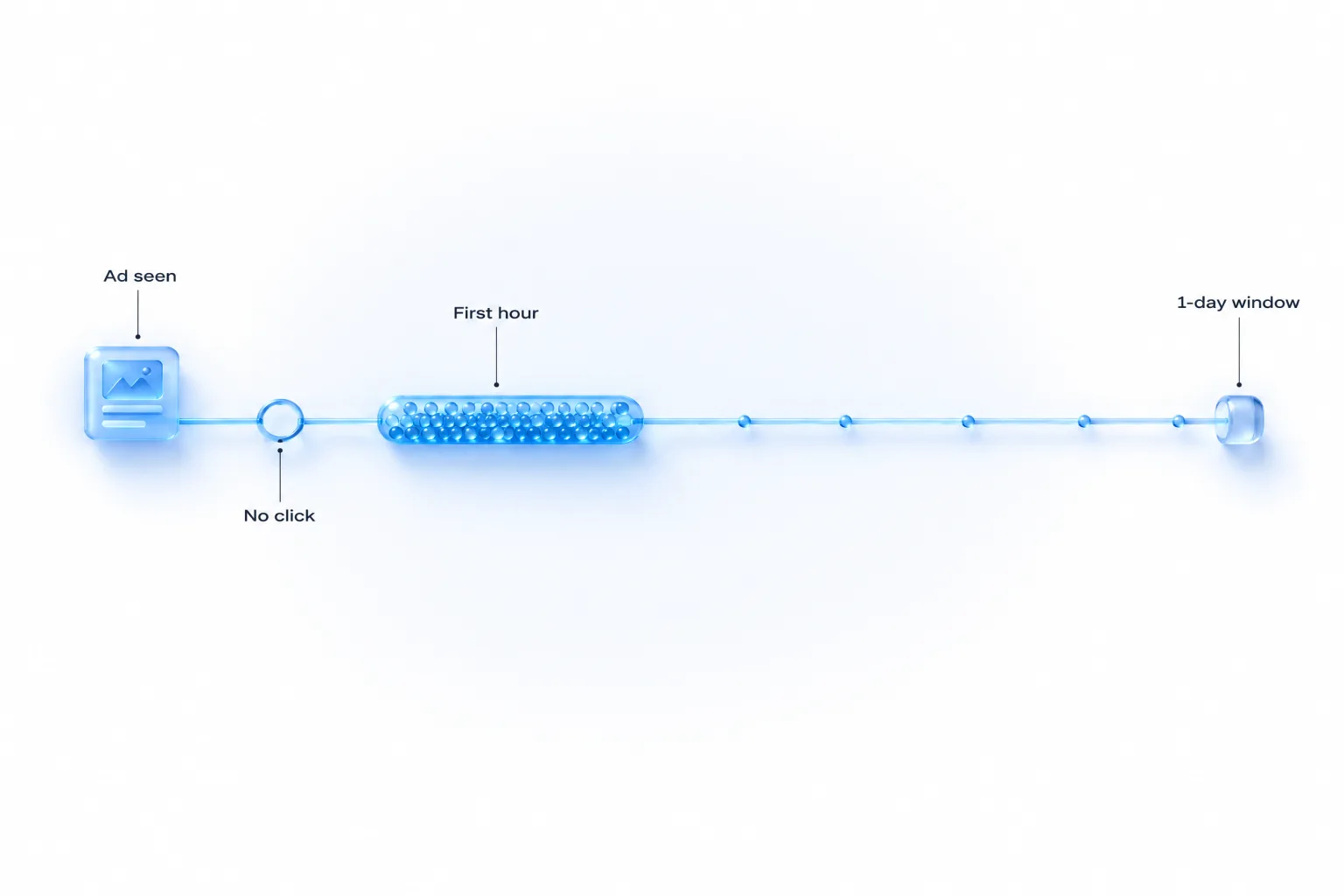
The most important new data in the measurement blog isn't a partner name. It is a statistic about how ChatGPT users behave after seeing an ad. OpenAI says that in an early analysis of global campaigns optimised for deeper-funnel outcomes, 52.7% of eligible one-day view-through conversions happened within an hour of the matched ad impression.
Why the first-hour figure matters
OpenAI's explanation is that people often come to ChatGPT to work through a task or decision, and clicking an ad may not be their next step. They finish the conversation, then act. Some go to the brand's site directly, some search for the brand, some open the app. None of those paths involve a click on the ad, so click-only reporting misses them.
The timing is what makes this credible. View-through attribution has a bad reputation in display advertising because long windows credit ads for conversions that would have happened anyway. Someone sees a banner, buys a week later, and the banner takes credit. A conversion within the hour after an impression in a conversation about that exact decision is a much tighter link. It doesn't prove the ad caused it, and only incrementality testing can do that, but it is a different kind of evidence from a seven-day display window.
It matters even more for the visual format. An ad shown while an image generates is, by design, something the user sees while waiting. Many users will look, register the brand, and carry on with their image. If the format is judged on clicks alone it will look weaker than it is. That is likely why OpenAI's measurement push and its visual format were announced together.
How the reporting and optimisation settings work
The measurement blog describes three settings. They are easy to confuse:
| Setting | What it does | What it does not do |
|---|---|---|
| Click-through attribution window | You choose a window that fits your buying cycle; controls which click-driven conversions appear in reports | Does not change how campaigns optimise |
| One-day view-through window | Can be included in reporting to count conversions that followed an impression without a click | Does not change how campaigns optimise |
| Advanced conversion optimisation | Learns from eligible click-through and view-through conversions for the selected goal; purchases from either path can inform future delivery | Is not a reporting setting; it governs delivery |
OpenAI states it plainly: the attribution settings “control attribution in reports; they do not change how campaigns optimize.” This is the most common confusion I expect to see in client accounts. Turning off view-through in reporting does not stop the optimiser learning from view-through conversions when advanced conversion optimisation is on. Turning it on does not make a CPC campaign optimise for it. Reporting is a lens on results, and optimisation is the engine. Set them separately and on purpose.
We covered the arrival of one-day view-through reporting in August 2026 in the news timeline, and the September announcement that conversion optimisation would include view-through conversions. The new blog confirms that model, describing advanced conversion optimisation as learning from both click-through and view-through conversions.
How to report view-through without fooling yourself
- Report click-through and view-through separately, always side by side, never as one blended “conversions” number in a management deck.
- Watch the share. If view-through conversions are more than about half your total for a campaign, treat its efficiency with suspicion until an incrementality test supports it. Visual placements may run higher than text, so set your threshold per format once you have data.
- Check the time-to-convert pattern. If your view-through conversions cluster in the first hour, as OpenAI's aggregate does, that is a healthy sign. If they are spread evenly across the day, the ads are probably getting credit for baseline demand.
- Exclude existing customers when you can. View-through credit is most inflated for people who were going to buy anyway. Using custom audiences to exclude recent purchasers makes view-through numbers mean more.
Layer three: incrementality and geo-based experiments
Attribution tells you which conversions followed an ad. Incrementality tells you which conversions happened because of the ad. OpenAI calls incrementality measurement an important part of understanding advertising's business impact, and is open that its work here is “still in its early stages.” It is partnering with Haus, Measured and WorkMagic to explore geo-based experiments, and says the aim is to learn together how advertisers should run experiments and read the results as the platform develops.
How a geo-lift test works
A geo experiment splits a country into regions such as states, metro areas or postal clusters, and assigns some to receive ads (test) and others to have ads held out (control). Because the split is by geography, not by individual user, it doesn't need user-level tracking. It measures total business outcomes in each region, such as orders, revenue or sign-ups from any source. The difference between test and control, adjusted for how the regions behaved before the test, is the incremental effect of the ads.
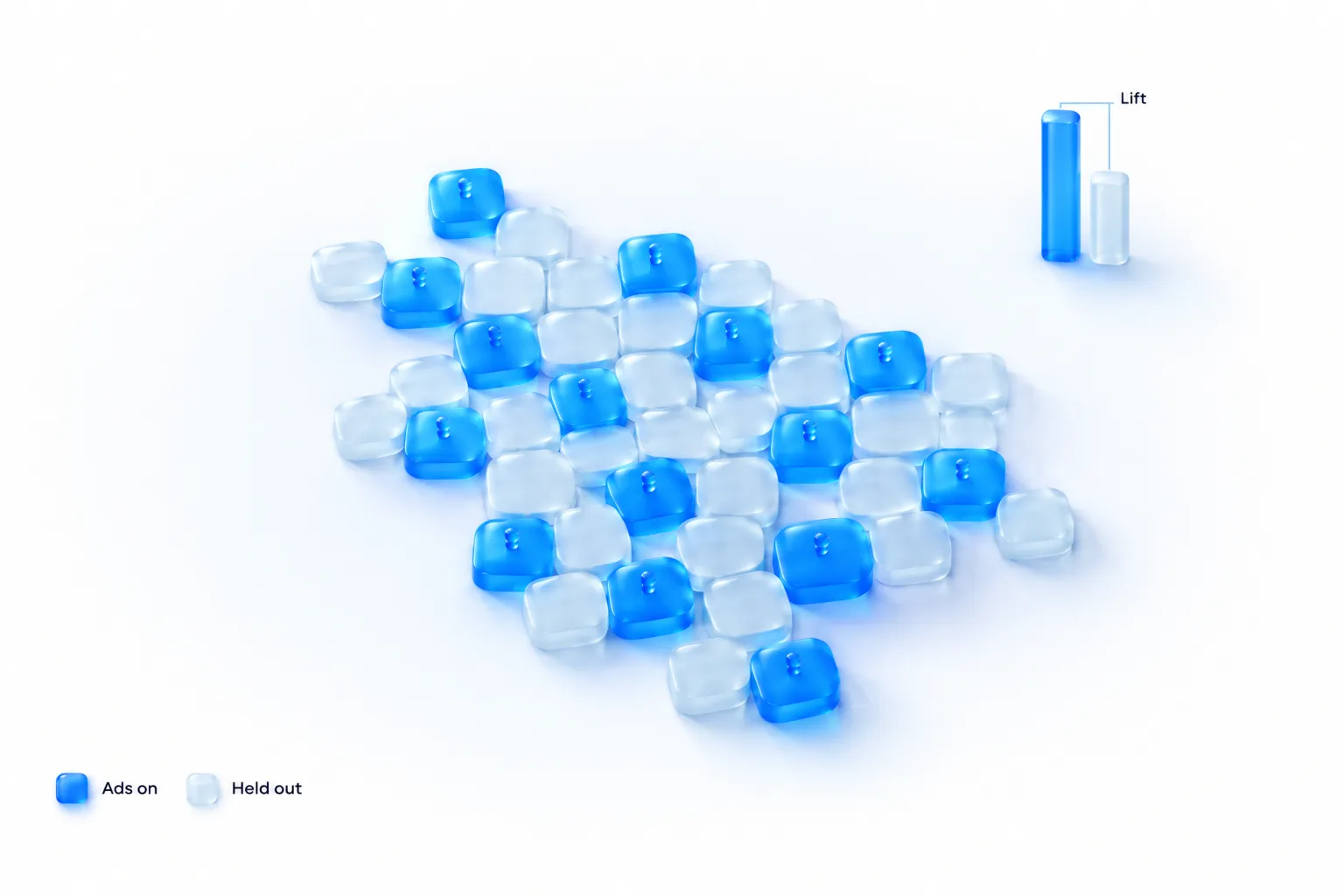
Geo tests suit ChatGPT Ads well for a reason that goes beyond technique. OpenAI's principles keep conversations private and limit the data advertisers get back. A geo test needs none of that. It only needs to control where ads run and to see your own sales by region. That fits a platform built around conversation privacy.
Designing a geo test for ChatGPT Ads
The partners will provide their own methods. These are the design decisions you will face either way:
- Pick the outcome metric from your own systems. Total orders or revenue by region from your commerce platform, not platform-attributed conversions. The point is to measure without trusting any attribution model.
- Check your geographic resolution. You need to measure outcomes by region and to control ad delivery by region in Ads Manager. Confirm what location targeting your account supports before you design the split.
- Balance the regions. Match test and control on historical sales, seasonality and size. Partners like Haus and Measured use synthetic-control methods for this. It is the hardest part to do well by hand.
- Power the test. Small budgets produce small effects that disappear into regional noise. If ChatGPT is a small fraction of total spend, you may need a higher-than-normal budget during the test, or a longer test, to detect a realistic lift.
- Freeze everything else. Don't launch a TV flight or a Meta promotion in only the test regions mid-experiment.
- Pre-register the decision. Write down before launch what result would increase, hold or cut budget. A geo test with no decision rule turns into a debate.
A worked sizing example
These are illustrative numbers, not a benchmark. Say a DTC brand averages 1,000 orders a day nationally and wants to detect a 3% lift from ChatGPT Ads in the test half of the country. The test half produces about 500 orders a day, so a 3% lift is about 15 extra orders a day. Daily regional order counts often swing by much more than 15 on their own. That is why geo tests usually run for several weeks, so the signal can build up above the noise. If the brand's ChatGPT budget is only large enough to plausibly drive a 1% lift, the test needs far longer or a higher budget during the test. This is exactly the design work the partners exist to do, and why OpenAI calls the programme early-stage rather than self-serve.
What the early incrementality results show
Two results in the blog come from incrementality methods, not attribution:
- WorkMagic and Dose. OpenAI reports that WorkMagic measured statistically significant lift for the wellness brand Dose, with 67% of incremental purchases coming from net-new customers. Separately, WorkMagic's geo-lift study estimated 2.3 times more incremental orders for Dose than last-click attribution captured.
- INCRMNTAL. The blog's results panel credits INCRMNTAL with a finding that 100% of campaigns delivered incremental conversions, with all campaigns showing statistically significant lift across travel, fintech, software and other verticals.
The Dose figure of 2.3 times is the most important number in the announcement for anyone defending a ChatGPT budget. If it generalises, last-click reporting substantially undercounts what the channel delivers. That is consistent with the first-hour view-through behaviour. Both point the same way: ChatGPT users act after the conversation, not by clicking. I look at the limits of these figures in the results section below.
Layer four: brand measurement with Kantar and Cint
The last layer is newest. OpenAI says that as it begins experimenting with new placements, it is in early-stage testing with Kantar and Cint to measure the effect of ChatGPT Ads on brand resonance metrics. Kantar is one of the best-known names in brand research. Cint runs a large research-panel marketplace used to field survey-based measurement.
Brand-lift studies usually survey people who were exposed to ads and a matched group who weren't, then compare measures like ad recall, awareness, consideration and purchase intent. For a visual placement, that is the natural success measure. An image seen during a wait is the classic upper-funnel exposure. The phrase “as we begin experimenting with new placements” suggests OpenAI expects new formats, the visual one included, to be judged partly on these metrics.
What to do now:
- If you are in the visual test group, ask your OpenAI contact whether a brand-lift study is available for your flight. Early-stage programmes often look for willing advertisers.
- Set up your own brand baseline before the test: branded search volume, direct traffic and branded mentions in ChatGPT answers. Our guide to tracking ChatGPT visibility covers the organic side.
- Agree in advance which brand metric matters. Recall and awareness are easy to move. Consideration and intent are the ones a CFO will accept.
The early results, read critically
The measurement blog presents five headline results, each credited to a named partner, and the main announcement repeats several of them. Here they are in one place, with what each one actually measures:
| Figure | Advertiser | Measured by | Method | What it measures |
|---|---|---|---|---|
| 15.3% lower CPA | WeightWatchers | DV Rockerbox | Attribution | Attributed cost per acquisition on ChatGPT Ads compared with its blended paid-search benchmark |
| 67% net-new | Dose | WorkMagic | Incrementality | Share of incremental purchases that came from net-new customers, alongside statistically significant lift |
| 2.3x | Dose | WorkMagic | Geo-lift vs last-click | Incremental orders estimated by geo-lift compared with orders captured by last-click attribution |
| 100% of campaigns | Multiple, across travel, fintech, software and others | INCRMNTAL | Incrementality | Share of studied campaigns showing statistically significant incremental conversions |
| 93% new visitors | Portland Leather Goods | Triple Whale | Site analytics | Share of visitors from ChatGPT Ads who were new to the site |
| 83% more revenue per 1K impressions | Same advertisers, compared across channels | Fospha | Daily media-mix attribution | Revenue per thousand impressions on ChatGPT versus the paid-social average across the same advertisers |
| 52.7% within an hour | Global campaigns optimised for deeper-funnel outcomes | OpenAI's own analysis | View-through timing | Share of eligible one-day view-through conversions that happened within an hour of the impression |
What the figures support
Together, the results support three cautious claims. First, ChatGPT Ads reach people advertisers weren't already reaching: 93% new visitors for Portland Leather Goods and 67% net-new among Dose's incremental purchases both point that way. Second, last-click undercounts the channel: the 2.3x figure and the first-hour view-through pattern agree. Third, on cost, the channel can compete with search: a 15.3% lower attributed CPA than blended paid search, for one advertiser.
What they don't support
- They are selected results. Vendors announcing a partnership publish their best case studies. Five strong results across several partners tell you good outcomes are possible, not how often they happen. No distribution of results, median or failure rate was published.
- Different methods, different meanings. A lower attributed CPA, a share of new visitors and an incremental-orders multiple can't be added together. Each needs its own reading.
- “New visitors” isn't incrementality. A visitor who is new to the site may still have become a customer through another channel. The 93% figure says the audience is new, not that the sales were caused by the ads.
- Benchmarks are the advertiser's own. “Blended paid-search benchmark” and “paid-social average” depend on each advertiser's mix. They show that ChatGPT beat those advertisers' other channels, not a market-wide standard.
- Revenue per impression isn't profit. The Fospha comparison is per thousand impressions. If ChatGPT impressions cost more than paid-social impressions, higher revenue per impression may not mean better return on spend.
- “100% of campaigns” depends on which campaigns were studied. The sample size and selection weren't published.
- None of these are visual-format results. Every result predates the visual format and comes from standard units. Visual ads will need their own evidence.
My advice to clients is the same as with any platform-published case study. Use these numbers to justify running a test, not to set expected results. Then run the test in your own measurement system, ideally with a holdout. Our guide to measuring ROI on ChatGPT Ads sets out a holdout design that holds up in a finance review. Our case studies page tracks the public spend data that has come out since launch.
Brand safety and suitability: how ChatGPT decides where ads can appear
The third part of the announcement covers trust: how confident advertisers can be about where their ads appear. OpenAI says confidence in advertising depends on understanding the environment ads can appear in, and that its ad policies and guardrails are designed to protect users, preserve trust and give brands confidence in their placements.
Placement guardrails
The main mechanism is what OpenAI calls placement guardrails: systems that judge whether a conversation is appropriate for advertising at all. They keep ads out of emotionally vulnerable, sensitive or otherwise unsuitable contexts. This happens before any auction. If a conversation fails the guardrail, no advertiser can appear in it, whatever the bid.
OpenAI's ad policies spell out what counts as inappropriate. There are two groups. The first is inappropriate categories, harmful or controversial topics including child safety, circumventing safeguards, cyber abuse, dangerous activities, debated social content, fraud, graphic sexual content, graphic violence, hate and harassment, illicit content, IP infringement, misinformation, obscenity, political content, privacy, regulated goods such as gambling or tobacco, suicide and self-harm, terrorism and weapons. The second is vulnerable user–model interactions: emotionally reliant contexts, mental and personal health conversations, and sensitive user journeys.

One nuance changed during 2026. In version 1.1 of the policies (April 2026), OpenAI refined placement in some regulated-advice contexts: medical, legal and financial advice conversations are no longer blocked from ads by default, while sensitive conversations and the other prohibited contexts stay ineligible. So “a conversation about health” isn't automatically ad-free. A conversation showing vulnerability is. The difference matters to advertisers in those categories, and it is why guardrails judge each conversation rather than applying a simple topic blocklist.
Review, oversight and monitoring
OpenAI says automated review, human oversight and ongoing monitoring help it find and fix policy violations and improve its safeguards over time. The ad policies describe the process in three stages. Advertisers are checked at sign-up. Each ad's title, copy, media and landing page are reviewed when uploaded. And a final placement check makes sure approved ads only appear in compliant conversations. Most reviews are automated, using machine-learning systems including LLMs and classifiers, with human calibration. Higher-risk decisions are escalated to people. Ads or landing pages the systems can't evaluate are not allowed to run, which is worth remembering if your landing page blocks crawlers or hides content behind scripts.
Negative Phrases: brand-specific exclusions
Platform guardrails reflect OpenAI's view of what is unsuitable for everyone. Brands often have narrower rules of their own. A children's brand may avoid conversations about horror films. An airline may avoid conversations about crashes even when they are factual and calm. A luxury brand may avoid discount-hunting contexts. For these cases OpenAI says Negative Phrases are now available to qualifying advertisers, aimed at “narrow placement requirements specific to a brand's own policies.”
The announcement doesn't publish the qualification criteria, how phrases are matched against conversations, or how many phrases are allowed. The wording (“narrow placement requirements”, “qualifying advertisers”) suggests a targeted tool, not a broad blocklist. That fits a platform where matching works on meaning rather than keywords. Until OpenAI documents the matching, these principles will serve you well:
- Start from your written brand-safety policy. If your company already has a suitability policy for social and programmatic, translate its narrow exclusions into phrases, not its broad categories. OpenAI's guardrails already cover the broad ones.
- Keep the list short and specific. In keyword-based systems, long negative lists quietly cut reach because they block harmless conversations that share a word. In a conversational system, the safest assumption is that over-exclusion costs reach until proven otherwise.
- Exclude situations, not words. Write phrases that describe the context you want to avoid (“flight accident news”), not single words (“crash”) that also appear in harmless contexts like “crash course”.
- Review delivery after adding phrases. If volume drops sharply, your list is probably too broad.
- Treat Negative Phrases as separate from context hints. Context hints tell the system where you want to appear. Negative Phrases tell it where you must not. Plan them together and keep them consistent. A hint that describes a context your negatives exclude wastes budget.
Independent evaluation: DoubleVerify and IAS pilots
The most unusual part of the trust announcement is how verification will work. OpenAI says it is developing brand suitability evaluation pilots with DoubleVerify (DV) and Integral Ad Science (IAS). These are the two companies most large advertisers already pay to check where ads appear on the open web, social and video.
On the open web, verification works by scanning the page an ad loads on and classifying it. In ChatGPT the “page” is a private conversation, and OpenAI's principles rule out handing those to third parties. So OpenAI describes a different model: independent partners assess how its brand safety standards are applied in a controlled testing environment, without accessing private user conversations. The stated goal is more transparency about how the safeguards work while keeping conversations private.
In practice this audits the system, not your individual impressions. The verifier can run test scenarios, such as sensitive conversations, borderline contexts and adversarial cases, and judge whether the guardrails keep ads out when they should. What advertisers won't get, at least from what has been described, is impression-level proof that their own ads ran next to suitable conversations. That is a real difference from verification on the open web, and buyers should understand it before they promise their brand-safety teams something the pilots won't deliver.
The two CEOs' statements frame it the same way. Lidiane Jones of IAS describes an independent evaluation of how OpenAI's safeguards perform across a broad and changing range of scenarios. Mark Zagorski of DoubleVerify describes ChatGPT as an environment where context is set by the conversation itself, not a page or video, and stresses bringing independent measurement in while respecting user privacy. Both are describing the controlled-environment model, not log-level placement reporting.
What to tell your brand-safety team
If you work at a large advertiser, here is a short version you can forward:
- ChatGPT applies platform-wide placement guardrails before any auction. Sensitive and vulnerable conversations carry no ads, for anyone.
- Categories that are disallowed or need case-by-case approval are set out in OpenAI's ad policies.
- Qualifying advertisers can add Negative Phrases for brand-specific exclusions.
- DV and IAS are developing pilots that evaluate the safeguards in a controlled test environment. They don't see real user conversations, and won't produce impression-level placement logs as described.
- For the visual format specifically, the ad sits apart from the generated image, is clearly labelled, and doesn't influence the generated output.
The ads principles, and what they mean for advertisers
OpenAI ends the announcement by tying everything back to its ads principles: ChatGPT's answers stay independent, conversations stay private, and users remain in control of their experience. These aren't just values statements. Each one limits what advertisers can buy and what data they get back.
| Principle | What it means in practice | What advertisers cannot get | What advertisers can do instead |
|---|---|---|---|
| Answers stay independent | Ads don't influence ChatGPT's answers, and in image generation the ad stays separate from the image | Paid placement inside answers or generated images | Earn presence in answers organically; see how to appear in ChatGPT answers |
| Conversations stay private | Measurement and verification are built without exposing conversation content | Conversation transcripts, prompt-level reporting, page-style verification logs | Geo experiments, brand-lift studies, aggregate reporting, first-party conversion data |
| Users stay in control | Users can manage their ad experience; paid tiers are ad-free | Reach into Plus, Pro, Business or Enterprise users | Reach those users through organic visibility and other channels |
The first principle has a direct consequence for strategy. The visual ad and the user's generated image are separate by design, so paid and organic visibility on ChatGPT are separate jobs. You can buy the space next to the output, but not the output. If ChatGPT recommends your competitor in its answers, no ad budget changes that. Our guide to why ChatGPT recommends competitors explains the organic side. The brands that win on ChatGPT will run both: ads for presence at the moment of decision, and earned visibility for the answer itself.
Strategic read: what this announcement signals
Taken together, the three parts of the announcement show where ChatGPT Ads is heading. OpenAI says so itself: the updates are part of a broader aim to help people discover products and services, evaluate options and make decisions in ChatGPT, and it will keep developing the platform with new formats and capabilities to help businesses of all sizes reach customers. Here is how I read that.
1. ChatGPT Ads is becoming a full-funnel platform
Until now, ChatGPT Ads has worked mostly as a lower-funnel, intent-driven channel. The appeal was catching people mid-decision. A visual format, brand-lift measurement and view-through optimisation are all upper- and mid-funnel tools. OpenAI is building for brand budgets as well as performance budgets. For advertisers, the case for ChatGPT will increasingly be made in brand terms, not just CPA.
2. Measurement is being opened to outside checks
Supporting the attribution, MMP and media-mix vendors that advertisers already use is a deliberate move away from “trust our dashboard”. That is how a platform behaves when it expects its numbers to hold up under outside scrutiny, or at least wants to look that way. It also means ChatGPT will be compared directly with Meta, Google and TikTok in the same reports, which helps strong campaigns and exposes weak ones.
3. Privacy-safe methods are the default
Geo experiments, sealed-environment verification, aggregate brand lift: each new measurement capability was designed to work without exposing conversations. Advertisers who rely on user-level, log-file measurement will find ChatGPT harder to fit into their stack. Advertisers comfortable with experiments and models will find it easier. If your measurement practice is all user-level attribution, ChatGPT is a good reason to build experiment skills.
4. Placements are being designed around user behaviour
Putting the first visual ads in image generation shows OpenAI designing ad surfaces around moments in the product, not just adding inventory to existing screens. Expect more of that: placements tied to specific product moments, each with its own creative format. The skill that will matter is mapping your brand to the moments where users are already thinking about what you sell.
5. The gap between early movers and everyone else will widen
Every capability in this announcement rewards advertisers who already have their basics in place: clean conversion signals, a working attribution setup, image libraries, written brand-safety policies, and the habit of running tests. Advertisers who are still setting up their first campaign will be catching up for longer. If you are in that group, our step-by-step guide to running ads on ChatGPT is the place to start, and our setup service exists for teams that would rather not build it themselves.
Where visual ads fit in a complete ChatGPT strategy
Every capability OpenAI announced sits on the paid side of ChatGPT. Most of what decides whether a brand does well on ChatGPT sits on the organic side: whether the model mentions you, recommends you and cites your pages when users ask about your category. The two sides are kept apart by OpenAI's own principles. Ads don't influence answers, and in image generation the ad stays separate from the image. In practice they still affect each other, and a sound plan treats them as one system.
The four moments where a brand can show up
| Moment | Organic presence | Paid presence | Who controls it |
|---|---|---|---|
| User asks a category question | Mentioned or recommended in the answer | Standard sponsored unit beneath the answer | Model (organic), auction (paid) |
| User compares options | Included in the shortlist, with accurate attributes | Standard unit matched by context hints | Model (organic), auction (paid) |
| User creates an image for a project | None. The generated image is not a channel brands can enter | Visual ad during generation (testing) | Auction only |
| User shops a product category | Product information the model can draw on | Product feed ads and carousels | Model plus feed (organic), auction (paid) |
The third row is new, and unusual. It's the first ChatGPT moment where paid is the only way in. In text conversations a brand can earn a mention. Nobody can earn a place inside a user's generated image, and OpenAI's separation rule makes sure nobody can buy one either. The ad slot beside the image is the only commercial presence available. That makes the visual format strategically different from the standard unit. It doesn't compete with your organic visibility. It reaches a moment your organic work never could.
How the two sides support each other
- Organic visibility makes ads work better. A user who has seen your brand recommended in a ChatGPT answer recognises it in an ad. In my experience, recognition lifts click-through and conversion on any channel, and there's no reason ChatGPT is different.
- Ads fill the gaps in organic coverage. Where ChatGPT recommends competitors in a category, paid presence keeps you in the decision while the organic work catches up. Our guide to buyer-evaluation visibility covers that backstop.
- Visual ads build the recognition organic depends on. Brand familiarity influences what people ask for by name, and branded demand is one signal that shapes how often a brand is discussed and cited. If the brand-lift work with Kantar and Cint shows visual exposure raises awareness, that awareness feeds back into the questions users ask.
- Measurement should cover both. Track ChatGPT brand mentions (organic) next to ad results (paid) in one weekly view. Our guide to ChatGPT visibility metrics sets out a dashboard that combines them.
This connection between earned and paid is the centre of how we think about ChatGPT at Context Hints. The visual format sharpens the point. There is now a ChatGPT moment that only paid can reach, next to moments where organic is the stronger lever. Plans that treat the two as separate budgets owned by separate teams will miss how they reinforce each other.
Questions to ask before joining the visual test
If OpenAI or your account contact invites you into the first group, or when access opens more widely, get answers to these before you commit budget and creative time. They are the gaps in the public announcement that most affect whether a test teaches you anything.
Format and creative
- What image dimensions, file types and frame counts are supported? Is there a single-frame option and a multi-frame option, as the mockup suggests?
- Is text allowed on images, and if so, how much?
- What are the headline and description limits, and is the call-to-action label fixed or selectable?
- Who decides between the hero layout and the scrolling layout: the advertiser or the system?
- Are there specific review guidelines for the visual format beyond the general ad policies, particularly on interface imitation?
Delivery and buying
- How is the visual ad matched to an image-generation session? Do context hints apply, or is there a separate mechanism?
- What buying models are available: CPM, CPC, conversion-optimised?
- Is there a frequency cap, and can advertisers control it?
- Is the visual format a separate campaign type, or an ad format inside existing campaigns?
- What volume should a test advertiser expect in the first weeks?
Measurement and reporting
- Does reporting separate visual-format impressions, clicks and conversions from standard units?
- Are there per-frame or per-tile metrics, like the carousel card reporting for product feed ads?
- Are view-through conversions reported for visual impressions on the same one-day window?
- Is a Kantar or Cint brand-lift study available for test advertisers?
- Can a geo-holdout be set up for the visual format alone?
Safety and controls
- Do Negative Phrases apply to image-generation sessions the same way as to text conversations?
- What can users do from the overflow menu: hide, report, see why they saw the ad?
- Will the DV and IAS evaluations cover the image-generation placement?
Write the answers down and date them. Test-phase rules change quickly, and in three months you'll want to know which rules applied when your results were recorded.
Reporting visual ads to leadership
New formats get cut when the people who approve budgets don't understand how they're measured. A visual placement judged partly on view-through and brand metrics is especially exposed. This is the one-page structure I use for new-format reporting. It works because it separates what is proven from what is suggested.
| Section | Contents | Evidence grade |
|---|---|---|
| 1. Spend and delivery | Spend, impressions, reach, frequency; visual vs standard | Fact (platform-reported) |
| 2. Click-driven results | Clicks, click-through conversions, cost per new customer | Attributed (rules-based) |
| 3. View-driven results | View-through conversions, share of total, time-to-convert pattern | Attributed, lower confidence |
| 4. Third-party view | The same period in your MTA, MMP or MMM | Attributed or modelled (independent) |
| 5. Causal evidence | Geo-lift or holdout result, if run | Causal (strongest) |
| 6. Brand evidence | Brand-lift study or baseline movement in branded search and mentions | Survey-based or directional |
| 7. Decision | Scale, hold or stop, against the pre-registered rule | — |
The “evidence grade” column is the important part. It stops a view-through number being presented with the same confidence as a geo-lift result, and it shows leadership what would make the case stronger. If sections 5 and 6 are empty, say so and say what it would take to fill them. Being honest about what you don't yet know protects a new channel better than an inflated ROAS figure.
What changes for agencies and in-house teams
For agencies running ChatGPT for clients, the announcement adds work in four places.
Creative production becomes a ChatGPT deliverable
Until now, ChatGPT Ads creative was mostly copywriting: short headlines, short descriptions and a thumbnail. The visual format brings art direction, shoots and rights management into the ChatGPT scope. Agencies that run ChatGPT inside a search team will need to borrow skills from social and creative teams, or partner with them.
Measurement set-up becomes a bigger project
With ten attribution partners, three signal integrations and several incrementality and full-funnel partners, every client now has a “which route” decision. That is set-up work, often billable, and getting it wrong is costly. Duplicate conversions from two pipelines running at once are the most common problem I see. Our tracking implementation service exists for exactly this, and the partner guide covers the decision.
Brand-safety conversations get more specific
Large clients will ask whether DV or IAS can verify ChatGPT placements. The honest answer is the controlled-environment model described above. Agencies should explain that model before clients assume it works like open-web verification. Negative Phrases also become a managed list that needs an owner, a review schedule and a record of changes.
Reporting needs evidence grades
With view-through conversions feeding optimisation and brand lift in testing, a monthly report that just shows “conversions” is no longer good enough. Adopt the evidence-graded structure above, or something like it, before the first client asks why ChatGPT's conversion count doesn't match their MTA.
For in-house teams, the same four changes apply with fewer people to share them. The practical answer is to decide one owner per layer: one person for creative, one for signals and attribution, one for brand safety. A new channel spread loosely across everyone usually ends up owned by no one.
A worked scenario: one brand's first quarter with visual ads
Here is an illustrative scenario that puts the pieces together. The brand, numbers and outcomes are made up to show the decisions involved. They are not forecasts or real results.
The brand
“Larkfield Home” is a fictional US direct-to-consumer furniture brand selling small-space sofas, storage and lighting. It has run standard ChatGPT Ads since June 2026 on a Conversions objective, with pixel and Conversions API in place and an Event Quality Score it has worked to improve. It uses Northbeam for cross-channel attribution and gets its photography from an in-house studio.
Weeks 1–4: preparation
When the 15 October announcement lands, Larkfield's performance lead doesn't wait for access. The team:
- Audits its image library and finds most paid-cleared images are catalog shots on white. Only a dozen lifestyle images are cleared for paid use, so it books a two-day shoot.
- Chooses two audience moments that match common image-generation prompts: “first apartment” and “living room refresh”.
- Briefs five frames per concept using the template above, with safe margins and a type-free hero variant.
- Confirms in Northbeam that ChatGPT appears as its own channel, and writes down Northbeam's attribution window next to the Ads Manager click-through window it uses for reporting.
- Records a pre-test brand baseline: branded search volume, direct traffic, and how often ChatGPT mentions Larkfield in answers to a fixed set of 40 category prompts.
- Writes a decision rule: scale the visual format if incremental cost per new customer comes within 20% of its standard-unit cost per new customer, hold if within 40%, stop beyond that.
Weeks 5–8: first access
Say Larkfield gets access in this period, either through the test or a wider opening. It launches the two concepts with standard-unit budgets unchanged. Three things happen that are typical of new formats:
- One frame is rejected. A “living room refresh” frame showing two wine glasses on the coffee table is flagged. The glasses are arguably incidental, but the team replaces the frame rather than appeal, because speed matters more than the argument.
- Delivery is uneven. “First apartment” delivers steadily. “Living room refresh” under-delivers in week one and recovers in week two. The team doesn't change anything in week one, because it can't yet tell whether the problem is the creative or the test inventory.
- Clicks are low, view-throughs are not. Visual click-through runs well below the standard unit's, but one-day view-through conversions are a large share of the visual total, and most of them arrive within the first hour. That matches the pattern OpenAI reported.
Weeks 9–12: proving it
Click-driven cost per new customer for the visual format comes in well above the standard unit, and on that number alone the test would be stopped. The view-through and new-customer patterns suggest clicks miss most of the effect. So the team runs a four-week geo-holdout with its MMM vendor, keeping the visual format off in a matched set of regions.
The geo test shows a lift in total orders in the test regions that, when converted to an incremental cost per new customer, falls inside the “hold” band of the pre-registered rule. It isn't strong enough to scale. Larkfield keeps the visual format at test budget, retires “living room refresh” and replaces it with a “hosting season” concept for the holidays. It also sees a modest rise in ChatGPT answer mentions over the quarter, though it can't separate that from its organic content work, and says so in the report.
What the scenario shows
- Preparation takes longer than access. The shoot and rights work ran longer than any part of campaign setup.
- Click metrics alone would have produced the wrong answer. The decision only made sense with view-through patterns and a geo test.
- The pre-registered rule prevented an argument. “Hold” was an outcome everyone had already agreed to, not a compromise reached after the fact.
- Organic and paid effects are hard to separate. Honest reporting says so instead of claiming the credit.
What to watch next
This announcement opens several threads. These are the developments that would change the advice in this guide, roughly in the order I expect them:
| Signal | Why it matters | What would change |
|---|---|---|
| Published visual-format specs | Turns the creative-kit guidance from preparation into production | Exact crops, frame counts and type rules replace the mockup reading |
| Buying model for visual ads | Decides whether visual is judged on CPM, CPC or conversions | Budget sizing and KPI choice |
| Targeting disclosure | Shows whether context hints, image prompts or something else drives matching | How concepts map to audience moments |
| Visual-specific reporting | Per-frame metrics would allow real creative optimisation | Sequencing and frame-testing advice |
| First visual-format case studies | The current results all come from standard units | Whether visual deserves more than a test allocation |
| Kantar and Cint brand-lift availability | Brand outcomes are the natural measure for this placement | How brand advertisers justify spend |
| Results from the DV and IAS pilots | Large advertisers' brand-safety teams will want independent findings | Whether enterprise brand budgets enter ChatGPT |
| Negative Phrases documentation | Qualification and matching rules decide how useful the control is | The Negative Phrases guidance in this guide |
| Expansion beyond the US and image generation | OpenAI calls image generation the initial surface | Whether visual becomes a core format or stays niche |
I'll update this guide as each of these lands, and log every change on the ChatGPT Ads news timeline.
Category playbooks for the visual format
Each category OpenAI currently allows will use the visual format differently. These playbooks are my planning notes per vertical. They assume the format launches broadly in something like the form OpenAI's mockup shows, and that matching follows what the user is creating. Both are reasonable expectations, not confirmed facts.
Ecommerce and direct-to-consumer retail
This is the category the mockup was designed around, and it has the most to gain. DTC brands already have product photography, already run image ads on social, and already use the attribution tools OpenAI now supports. The visual format lets them bring that creative into ChatGPT for the first time with images doing the main work.
- Lead with usage imagery. Catalog shots on white are already used in product feed carousels. The visual format is the place for lifestyle and in-use images that feeds can't carry.
- Connect it to your feed strategy. If you run feed campaigns, keep visual concepts at the category or collection level (“autumn knitwear”) and let the feed handle individual products. Doubling up on the same SKU across both wastes budget.
- Measure in your MTA tool from day one. If you use Triple Whale, Northbeam or DV Rockerbox, confirm ChatGPT appears as its own channel before the test, so visual results sit next to your Meta and Google numbers.
- Watch new-customer share. The 93% new-visitor figure for Portland Leather Goods and the 67% net-new figure for Dose suggest ChatGPT is mostly a prospecting channel for DTC. Judge visual ads on new-customer acquisition cost, not blended ROAS.
Our ecommerce service page covers how we run ChatGPT for retail clients across feed and standard units.
Home, furniture and home improvement
Interior and home-improvement prompts are some of the most common and most commercial things people ask image models for. Someone generating a kitchen redesign is planning a purchase that could cost thousands. That makes home the strongest natural fit for the format after food and grocery.
- Build room-level concepts (living room, bedroom, kitchen, outdoor) and style variants within each (modern, traditional, Scandinavian, industrial). Your concepts should match the way users describe rooms in their prompts.
- Show the finished room, not the product alone. The user is picturing a whole space. A sofa on white asks them to do the work. A sofa in a finished room does it for them.
- Local services should show the before-and-after honestly. Painters, landscapers and renovators can show real project results. Stay within the misleading-claims rules: real projects, accurate results, no implied guarantees.
- Expect long consideration cycles. Furniture and renovation decisions take weeks. Use a longer click-through attribution window in reporting and lean on brand-lift and incrementality more than on one-day conversion metrics.
Travel and experiences
Travel is in OpenAI's allowed categories, and travel is mostly about the experience. The “experiences a product makes possible” job was practically written for hotels, tours and destinations.
- Experience frames lead. The view from the room, the trail at sunrise, the dinner at the end of the day.
- Make the product recognisable. Experience imagery for travel easily becomes generic beach photos. Include identifying details in every frame: your property's architecture, your tour's signature stop, your branded welcome pack.
- Watch seasonality. Run imagery that fits the planning season, not the travel season. People plan summer trips in winter.
- Remember the alcohol rule. Travel imagery is full of sunset cocktails and wine dinners. Under the policy, incidental alcohol can pass when it isn't the focus. A cocktail as the hero of the frame won't.
Food, grocery and meal kits
OpenAI chose a grocery brand for its own demo, which is a strong hint about where it sees early fit. Recipe and meal images are a daily, repeat use case, and food is easy to photograph well.
- Show ingredients turning into dinner. The mockup's sequence (ingredients, then the finished dish) is the model to follow.
- Keep frequency in mind. Food is a high-frequency category. If the format lets you cap frequency, use it. Repetition during image sessions will feel intrusive faster than under text answers.
- Make the offer concrete. Grocery and meal-kit decisions are often driven by price. If the format allows on-image type, a first-order offer stated clearly will probably beat a mood line.
Digital products, apps and education
Digital products are allowed, and app advertisers are the main beneficiaries of the new MMP integrations. The creative challenge is that software is hard to photograph.
- Show the output, not the interface. A photo-editing app shows the edited photo. A language app shows the conversation the user can now have. A design course shows the finished design.
- If you show screens, show your own UI clearly. Never anything that looks like ChatGPT. Interface imitation is the main risk for software advertisers in this placement.
- Set up MMP attribution before the test. For app-install campaigns, confirm with AppsFlyer, Adjust, Branch, Singular, Kochava, Airbridge or Tenjin how ChatGPT appears as a source and that install and in-app events flow back.
- Education must avoid outcome guarantees. “Get a job in 12 weeks” is the kind of exaggerated result the misleading-claims policy targets. Show what students make, not promised outcomes.
Local services
Local services are an allowed category, but the visual test is US-wide and nothing has been said about local targeting in this placement. Local businesses should mostly watch and prepare.
- Build a small library of real work photos: completed projects, your team's vehicle or storefront, finished results. You'll need it for any visual format, on ChatGPT or elsewhere.
- Keep using the standard unit with precise local context hints. For most local businesses, intent in text conversations beats visual reach in image sessions.
- Make sure your landing page works on mobile. The mockup is a phone screen. Most image generation on the go happens on phones, and a slow, desktop-first landing page will waste whatever clicks you get.
Fashion and beauty
Outfit and look generation is a popular, heavily commercial image use case. Fashion and beauty brands should be ready, with two policy cautions.
- Apparel imagery must stay in a standard retail context. The policy allows lingerie and swimwear in standard fashion presentation but disallows sexualised poses. Shoot accordingly.
- Beauty claims fall under the wellness and health rules. Skincare with medical-style claims (“clears acne”, “reverses ageing”) risks rejection. Cosmetic results shown honestly, without medical claims, are safer.
- Avoid looking like a generated image. Flawless AI-style model renders are exactly what users in this placement are creating themselves. Real photography with visible texture and real fabrics makes your ad clearly an ad.
How ChatGPT visual ads differ from image ads elsewhere
Most advertisers will bring creative and expectations from social and display image ads. Some of that carries over and some doesn't. These differences come from how the placements work, not from published ChatGPT specs.
| Dimension | Social feed image ads | Display and programmatic | ChatGPT visual ads (as announced) |
|---|---|---|---|
| User state | Scrolling, passive, entertainment | Reading other content | Waiting for an image they asked for, focused on a project |
| Context signal | Interest and behaviour profile | Page content and audience data | The user's own creative request, unconfirmed as a targeting input |
| Competition for attention | Friends' posts, other ads | Page content, other ads | Very little; the output isn't ready yet |
| Exposure length | Fraction of a second per scroll | Variable, often ignored | Bounded by generation time, which varies |
| Verification | Platform reports plus third-party tags in some placements | Page-level third-party verification | Controlled-environment evaluation (DV, IAS pilots); no conversation access |
| Main creative risk | Thumb-stopping power | Banner blindness | Being mistaken for the generated output (interface imitation) |
| Paid-tier users | Generally reachable | Generally reachable | Not reachable; Plus, Pro and Business are ad-free |
The biggest difference is the user's state of mind. A social feed user isn't looking for anything. A ChatGPT image user is building something specific. Social creative is designed to interrupt. ChatGPT visual creative should help with what the user is already doing. An ad that feels like a useful suggestion for the user's project fits. One that feels like an interruption breaks the moment and, I suspect, will be scored down by whatever relevance system decides delivery. That is how the standard unit already behaves, with relevance as an auction input alongside bids.
One practical point about reusing creative. Square social images will probably adapt well to the scrolling-row layout. Vertical story and reel creative (9:16) almost certainly won't fit either layout in the mockup. Don't assume your social library is ready. Audit it against the wide-plus-square shapes the mockup suggests.
Readiness checklist: what to do before you get access
You can't buy the visual format yet unless you are in the first group. You can make sure you are ready the day it opens. This checklist is ordered by how long each item takes, longest first.
| # | Task | Owner | Lead time | Done when |
|---|---|---|---|---|
| 1 | Clear image rights for paid use on new channels | Brand / legal | 2–6 weeks | A list of images cleared for paid use, with licence terms recorded |
| 2 | Produce usage and experience imagery for 2–3 audience moments | Creative | 3–6 weeks | A full creative kit per concept (see kit table) |
| 3 | Fix conversion tracking and check Event Quality Score | Analytics | 1–3 weeks | Pixel and Conversions API deduplicated; EQS reviewed; value and currency on purchase events |
| 4 | Connect your attribution partner, if you use one | Analytics | 1–2 weeks | ChatGPT appears as a channel in your MTA or MMP; windows documented |
| 5 | Translate your brand-safety policy into Negative Phrases | Brand safety | 1 week | A short, situation-based phrase list ready for when you qualify |
| 6 | Write a measurement plan for the visual test | Performance lead | 2–3 days | Primary KPI, secondary KPIs, holdout or geo design, decision rule written down |
| 7 | Set up a brand baseline | Brand / analytics | 2–3 days | Branded search, direct traffic and ChatGPT brand mentions recorded for the pre-test period |
| 8 | Sign up or confirm your ChatGPT Ads account | Performance lead | 1 day | Account live at ads.openai.com; standard campaigns running to build history |
| 9 | Run a policy pre-check on every frame | Performance lead | 1 day | Interface-imitation, alcohol, adult, wellness and IP checks done per frame |
| 10 | Prepare mobile-first landing pages matched to each concept | Web | 1–2 weeks | Pages load fast on mobile and continue the image's message |
Item 8 needs a note. Running standard ChatGPT campaigns now, before the visual format opens, does three things. It builds account history and conversion data. It shows you how your conversion tracking behaves on ChatGPT traffic. And it gives you a text-unit benchmark to compare visual results against. If you aren't advertising on ChatGPT at all yet, start with the standard unit. Our audit is the fastest way to check an existing account is ready for a new format.
A 90-day plan for testing visual ads
Assuming you get access, whether in the first group or when the format opens more widely, this is how I'd structure the first 90 days.
Days 0–14: launch small, read everything
- Launch two concepts, not ten. Each one is a full sequence matched to one audience moment.
- Hold standard-unit budgets steady so you can see whether visual ads add volume or take it from your text ads.
- Check delivery daily for the first week. New formats in testing often under-deliver at first, and you need to know whether that's your creative or the inventory.
- Read click-through and view-through conversions separately from the start.
- Collect every review rejection and its reason. Early review outcomes are the best guide to unwritten creative rules.
Days 15–45: learn which job works
- Rotate frame order between concepts to see whether inspiration-first or usage-first sequences do better, if the format lets you control order.
- Compare the visual test with your standard unit on cost per new customer, not blended CPA.
- Watch the share of view-through conversions and how quickly they arrive. Check against the first-hour pattern OpenAI reported.
- If you have a brand-lift option through Kantar or Cint, field it in this window, when exposure volume is high enough for the survey to read.
Days 46–90: prove incrementality, then decide
- If budget allows, run a geo-holdout on the visual format, ideally designed with Haus, Measured or WorkMagic if you have access, or with your own MMM vendor.
- Retire the weakest concept and replace it with one aimed at a new audience moment.
- Present a decision based on the pre-registered rule: scale, hold or stop. Include the measured incremental cost per acquisition and what it would take to scale.
Budget sizing without published pricing
OpenAI hasn't published pricing for the visual format. The standard unit gives anchors. The default CPM bid in Ads Manager has been $60, with reported clearing rates by category nearer $25–60, and recommended starting CPC bids of $3–5. Our cost guide has the full history. A visual placement with high attention could price above that. A new, low-volume test placement could price below it. Size your test on the outcome you need, not on a guessed rate:
- Decide how many conversions you need to read the test. Thirty to fifty per concept is a common minimum for a directional read.
- Take your current ChatGPT standard-unit cost per conversion as the planning rate. If you have none, use your paid-social cost per conversion.
- Multiply: conversions needed × planning cost per conversion × number of concepts.
- Add 30 to 50 per cent as a buffer for early inefficiency and for the view-through conversions you'll want to watch but not count as primary.
An illustrative example: two concepts, 40 conversions each, at a $50 planning cost per conversion, plus a 40% buffer, comes to roughly $5,600 for a first read. Treat that as the smallest test that teaches you something, not a recommended budget.
A measurement plan template
VISUAL FORMAT TEST — MEASUREMENT PLAN

Test window:            [start] to [end]
Concepts:               A = ______   B = ______
Primary KPI:            cost per new customer (click-through, [X]-day window)
Secondary KPIs:         view-through conversions (1-day) and time-to-convert
                        brand lift (if available): consideration
Source of truth:        [MTA / MMP / MMM / Ads Manager]
Control:                standard-unit campaigns held at constant budget
Incrementality:         [geo-holdout design / none this phase]
Exclusions:             recent purchasers via custom audience
Decision rule:          scale if incremental CPA <= [target]
                        hold if within [range]
                        stop if > [ceiling] after [n] conversions
Signed off by:          [performance lead] [finance]
Twelve mistakes to avoid
- Treating the mockup as a spec. Building final-crop creative to the pixel dimensions of a launch mockup. Build masters with safe margins instead.
- Leading with the logo. The visual format is about products in use. A logo frame wastes the most valuable tile.
- Copying the AI-render look. Ad images that could pass for the user's generated output risk interface-imitation review and confuse users.
- Writing copy in ChatGPT's voice. “Here's your…” phrasing makes the ad sound like part of the answer.
- Forgetting the landing page. Policy applies end-to-end. A compliant image linking to a page with disallowed content fails review.
- Mixing attribution settings with optimisation. Changing reporting windows and expecting delivery to change. They are separate controls.
- Blending view-through into headline conversions. It inflates results and destroys trust in the channel when finance finds out.
- Over-broad Negative Phrases. Single-word exclusions that block harmless conversations and quietly shrink reach.
- Promising your brand-safety team placement logs. The DV and IAS pilots evaluate the system in a controlled environment. They don't report on individual impressions.
- Reading partner case studies as benchmarks. They justify a test. They don't predict your results.
- Testing without a working signal. Launching a new format on top of broken conversion tracking means you'll never know whether it worked.
- Pausing the standard unit to fund the test. You lose your comparison point and your account history in one move.
Glossary
- Visual ad format
- OpenAI's image-led ChatGPT ad unit, announced 15 October 2026, first tested during image generation for US Free and Go users.
- Image generation
- The ChatGPT feature that creates images from a user's prompt; the first placement for visual ads.
- Free and Go plans
- The ChatGPT plans whose users can see ads. Plus, Pro, Business and Enterprise are ad-free.
- Pixel
- OpenAI's browser-side tag that records on-site conversions for ChatGPT Ads.
- Conversions API (CAPI)
- The server-side route for sending conversion events to ChatGPT Ads, deduplicated against the pixel.
- Event Quality Score (EQS)
- OpenAI's assessment of the quality of the conversion signals an advertiser sends.
- MMP
- Mobile measurement partner: the attribution system app advertisers use across ad networks (AppsFlyer, Adjust, Branch, Singular, Kochava, Airbridge, Tenjin).
- MTA
- Multi-touch attribution: models that share conversion credit across several ad touches (for example Triple Whale, Northbeam, DV Rockerbox).
- MMM
- Media-mix modelling: statistical modelling of how each channel contributes to total outcomes, used by full-funnel partners such as Fospha, Measured and INCRMNTAL.
- Click-through conversion
- A conversion that follows a click on an ad, within the attribution window the advertiser chooses for reporting.
- View-through conversion
- A conversion that follows an ad impression without a qualifying click, reported in ChatGPT Ads with a one-day window.
- Advanced conversion optimisation
- ChatGPT Ads optimisation that learns from eligible click-through and view-through conversions for the selected goal.
- Incrementality
- The share of outcomes that happened because of the ads and would not have happened otherwise.
- Geo-lift / geo experiment
- An incrementality test that compares regions with ads on against regions with ads held out.
- Brand lift
- The measured change in brand metrics (recall, awareness, consideration, intent) among people exposed to ads compared with those who weren't.
- Placement guardrails
- OpenAI's systems that judge whether a conversation is appropriate for ads at all, before any auction.
- Negative Phrases
- Brand-specific placement exclusions now available to qualifying ChatGPT advertisers.
- Brand suitability evaluation
- The DV and IAS pilots that assess how OpenAI's safeguards perform in a controlled test environment, without access to private conversations.
- Interface imitation
- An ad-policy rule: ads must not imitate ChatGPT's appearance, functionality or voice in a way that could make users think the ad is part of the product.
The bottom line
The visual format is the headline, but the measurement and brand-safety news is what most advertisers can use today. For now, the visual format is a US-only test in one placement with a small group of advertisers and no published specs. The changes you can act on now are the attribution partners, the view-through data and Negative Phrases. Together they make ChatGPT Ads easier to measure and defend inside a real marketing budget.
If you take three things from this guide, take these. Prepare usage and experience imagery now, because production lead times are longer than access lead times. Get your measurement into the systems you already trust, because the visual format will be judged on outcomes that clicks undercount. And design every visual ad so it is clearly yours and clearly separate from what the user is creating, because that separation is the promise the format depends on.
I'll update this guide as OpenAI publishes specs, pricing and the first visual-format results. For the full picture of where ChatGPT advertising is heading, keep the news timeline open, and start with the complete ChatGPT Ads guide if you're new to the platform.
ChatGPT visual ads: frequently asked questions
What is the new ChatGPT visual ad format?
An image-led ChatGPT ad unit that OpenAI announced on 15 October 2026. It uses images showing product inspiration, product usage or the experiences a product makes possible, to help people discover a brand, understand what makes it different and decide what to buy. It is first being tested during image generation in ChatGPT.
Where do ChatGPT visual ads appear?
The initial test runs during image generation. While ChatGPT is creating an image a user asked for, a clearly labelled ad can appear below the image and above the chat composer. OpenAI says the ad stays separate from the image being created.
Who will see ChatGPT visual ads?
Users on the Free and Go plans in the US during the initial test. Plus, Pro, Business and Enterprise users are ad-free. Under OpenAI's ad rules, users who are under 18 or predicted to be don't see ads, and sensitive conversations carry no ads.
When do ChatGPT visual ads launch?
OpenAI said on 15 October 2026 that testing would begin “later this month” in the US with an initial group of advertisers, so late October 2026. That is a test, not a general launch. No date for wider availability has been published.
Can any advertiser buy the visual format?
Not yet. The test starts with an initial group of advertisers, and OpenAI hasn't published how they are chosen. Businesses can sign up for ChatGPT Ads at ads.openai.com. The announcement doesn't say whether that gives access to the visual test.
Do visual ads appear inside the image ChatGPT generates?
No. OpenAI says the ads stay separate from the image being created and that advertising doesn't influence ChatGPT's answers. An advertiser can't pay to have its product put into a user's generated image.
What are the image specs for ChatGPT visual ads?
OpenAI hasn't published specs. Its mockup shows two layouts: a single wide hero frame with dots indicating about five swipeable frames, and a horizontally scrolling row of square images. Prepare wide and square creative with safe margins until specs are released.
How much do ChatGPT visual ads cost?
Pricing for the visual format hasn't been published. For reference, the standard ChatGPT unit has defaulted to a $60 CPM bid, with reported clearing rates around $25–60 by category, and recommended starting CPC bids of $3–5. Size a visual test on the number of conversions you need to read it, not on a guessed rate.
Which measurement partners does ChatGPT Ads support?
Hightouch, Tealium and LiveRamp for sending conversion data. AppsFlyer, Triple Whale, Adjust, DV Rockerbox, Northbeam, Branch, Singular, Kochava, Airbridge and Tenjin for Conversions API, reporting and click attribution. Fospha, Measured and INCRMNTAL for full-funnel measurement. Haus, Measured and WorkMagic for geo-based incrementality experiments. Kantar and Cint for early-stage brand measurement.
What did OpenAI say about view-through conversions?
In an early analysis of global campaigns optimised for deeper-funnel outcomes, 52.7% of eligible one-day view-through conversions happened within an hour of the matched ad impression. Advertisers can include a one-day view-through window in reporting, and advanced conversion optimisation learns from both click-through and view-through conversions.
Do attribution window settings change how ChatGPT campaigns optimise?
No. OpenAI says the click-through and view-through window settings control attribution in reports only. Optimisation is governed separately: advanced conversion optimisation learns from eligible click-through and view-through conversions for the selected goal, whatever reporting window you choose.
What is a geo-based incrementality experiment?
A test that splits a market into regions, runs ads in some and holds them out in others, then compares total business outcomes between the two groups. The difference is the incremental effect of the ads. It needs no user-level tracking, which suits ChatGPT's privacy approach. OpenAI says its geo work with Haus, Measured and WorkMagic is at an early stage.
What were the early ChatGPT Ads measurement results?
DV Rockerbox measured WeightWatchers' attributed CPA 15.3% below its blended paid-search benchmark. WorkMagic found statistically significant lift for Dose, with 67% of incremental purchases from net-new customers, and estimated 2.3x more incremental orders than last-click captured. Triple Whale reported 93% of Portland Leather Goods' ChatGPT Ads visitors were new. INCRMNTAL reported all studied campaigns delivered incremental conversions. Fospha measured 83% more revenue per thousand impressions than the paid-social average across the same advertisers.
Should I treat those results as benchmarks?
No. They are partner-published case studies, selected by the companies announcing them, using different methods that can't be compared directly, and none of them come from the visual format. Use them to justify a test, then measure your own results, ideally with a holdout.
What are Negative Phrases in ChatGPT Ads?
A placement control now available to qualifying advertisers, for narrow exclusions specific to a brand's own policies. They work alongside OpenAI's platform-wide guardrails, which already keep ads out of sensitive and vulnerable conversations. Qualification criteria and matching details haven't been published.
How will DoubleVerify and IAS verify ChatGPT ads?
OpenAI is developing brand suitability evaluation pilots with both. The partners will assess how OpenAI's brand-safety standards are applied in a controlled testing environment, without accessing private user conversations. That evaluates the safeguards themselves. As described, it doesn't produce impression-level placement logs like open-web verification.
Which conversations never show ChatGPT ads?
OpenAI's placement policy rules out ads in sensitive or brand-unsafe contexts, including child safety, graphic violence, hate, political content, regulated goods, suicide and self-harm, terrorism and weapons, and in vulnerable interactions such as emotionally reliant contexts and mental or personal health conversations.
What creative mistakes should visual advertisers avoid?
Leading with a logo, copying the look of an AI-generated image, writing copy in ChatGPT's voice, including disallowed items such as a featured alcohol bottle, and linking to a landing page that breaks policy. OpenAI's interface-imitation rule says ads must be clearly distinguishable from the ChatGPT product experience.
Which businesses are the best fit for ChatGPT visual ads?
Consumer brands in OpenAI's currently allowed categories whose products show well in images: home and furniture, food and grocery, travel, fashion, consumer goods, and digital products or courses with a visible outcome. B2B software with no visual outcome and regulated categories should usually wait.
Is ChatGPT showing video ads?
The 15 October 2026 announcement covers images only. OpenAI's ad policies mention video among the asset types their standards apply to, but no video ad format has been announced.
Will visual ads expand beyond the US and image generation?
OpenAI describes image generation as the initial test surface and the US as the initial market. It says it will keep developing the platform with new formats and capabilities, but no expansion dates or placements have been announced.
What should I do now to prepare?
Clear image rights for paid use, produce usage and experience imagery for two or three audience moments, fix conversion tracking and check Event Quality Score, connect your attribution partner, translate your brand-safety policy into a short Negative Phrases list, and run standard ChatGPT campaigns now so you have a benchmark when the visual format opens.
Sources and further reading
- OpenAI — Building advertising for the way people use AI, 15 October 2026 (visual ad format, measurement partners, brand suitability, ads principles).
- OpenAI Ads blog — More ways to measure ChatGPT Ads, 5 October 2026 (partner list, five partner-credited results, 52.7% first-hour view-through analysis, attribution settings, Event Quality Score, Kantar and Cint testing, DV and IAS statements). Retrieved 16 October 2026.
- OpenAI — Ad policies, updated 10 September 2026, v1.6 (placement policy, content policy, interface imitation, allowed categories, review and monitoring). Retrieved 16 October 2026.
- OpenAI — ads.openai.com (advertiser sign-up).
- Context Hints — ChatGPT Ads news and timeline (pricing history, view-through reporting from August 2026, carousel reporting from September 2026).
Want to be ready when visual ads open?
30 minutes with Tarun. Bring your current ChatGPT account and your image library, and we will map which concepts to build, which measurement route fits your stack, and what to fix before the format reaches you.
Book a discovery callTarun Kapoor
Twelve years of media buying across GroupM, WPP, Ogilvy & Mather, and Neil Patel Digital. Has personally owned media for Nestlé, Sage, Qualcomm, Aetna, Weight Watchers, Chubb and Novotel.