How much do ChatGPT ads cost? A 2026 pricing and budget guide
 Tarun Kapoor
Updated 4 September 2026
18 min read
Tarun Kapoor
Updated 4 September 2026
18 min read
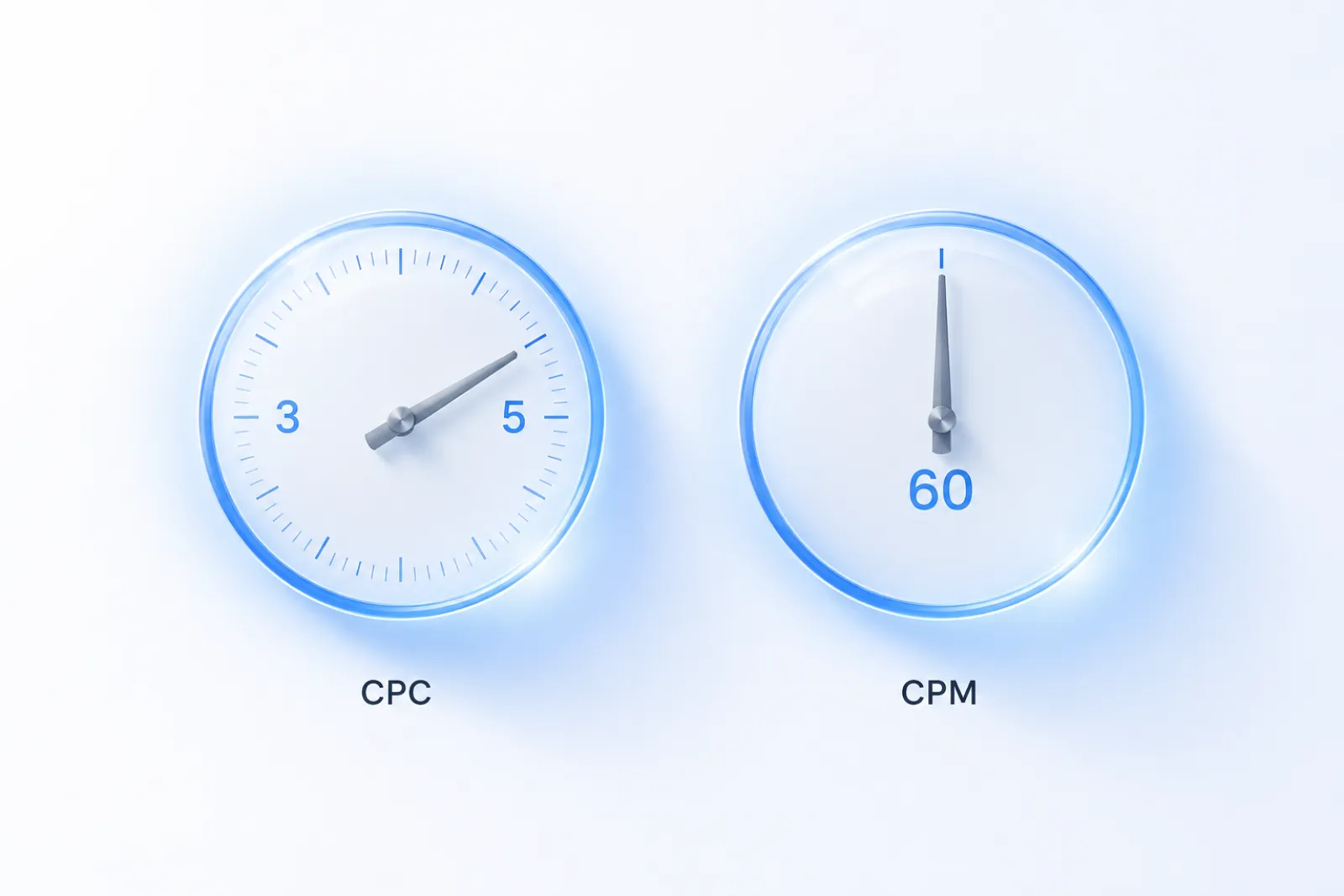
ChatGPT ads cost roughly $3 to $5 per click, or up to $60 per 1,000 impressions, based on OpenAI's recommended starting bids. Observed CPMs have fallen toward a $25-60 range as inventory grew, the minimum spend was removed when self-serve opened on 5 May 2026, and conversion campaigns added in June are still billed per click rather than per conversion. This guide covers what you pay, what to budget by business size, how the auction discounts relevance, and an honest read on whether it pays back.
The 2-sentence answer
ChatGPT ads cost $3–5 per click on OpenAI's recommended starting bid, or a $60 default maximum CPM for impression buying, with no minimum spend since self-serve opened on 5 May 2026. Because the auction is relevance-weighted and second-price, your bid is a ceiling rather than a price — sharpening relevance lowers what you actually pay more reliably than raising your bid does.
The short version
- CPC: $3–5 recommended starting max bid. Ads Manager ships a $3.00 default in a $0.01–$100 range. You usually pay less; bids under about $3 win little delivery.
- CPM: $60 default max bid. Observed clearing rates have reportedly fallen toward $25–60 by category.
- Minimum spend: gone. Reportedly $200,000 at launch, then $50,000, then removed on 5 May 2026 with self-serve buying.
- Conversion campaigns (oCPC, live 5 June 2026) are still billed per click — the Bid Cap is a click ceiling, not a cost per conversion.
- Daily budgets became seven-day averages on 27 July 2026: up to 2× on any day, 7× across the week.
- What sets your price: a relevance-weighted, second-price auction — better relevance lowers what you actually pay.
How much do ChatGPT ads cost?
You set the budget, and you pay through one of two billing models. For the Clicks and Conversions objectives you bid cost per click, and OpenAI recommends a starting maximum of $3 to $5. For the Reach objective you bid cost per 1,000 impressions, with a $60 default maximum. There is no platform fee on top; your spend is the media.
The headline numbers are simple. The useful parts are what you actually pay after the auction resolves, and what you should budget to learn anything at all. Both are below, along with an honest separation of the figures that come from OpenAI and the figures that come from blogs.
If you are already spending and the cost per result looks wrong, a ChatGPT Ads audit finds where the money is going; if you have not launched yet, our ChatGPT Ads setup builds the account to spend efficiently from day one.
ChatGPT ads CPC: what a click costs
CPC is the model most performance advertisers will start with. OpenAI's recommended starting maximum bid is $3 to $5 per click, and when the self-serve beta shipped, the max CPC field carried a $3.00 default placeholder inside a $0.01–$100.00 range. That default is a tell: it is roughly where OpenAI expected early auctions to clear.
That is a ceiling, not a fixed price. In a second-price auction your effective CPC is set by the competition just below you, so with strong relevance you frequently pay less than your max. The firm guidance from early accounts is that bidding much below $3 wins little or no delivery — the floor is real, and trying to buy clicks at $1 mostly buys silence.
Reported real-world CPCs vary widely. One publicly documented account cleared around $1.72 per click over a 15-day window, comfortably under the recommended range. At the other end, B2B categories have been reported in the $8–15 range. The spread reflects competition density by category more than bidding skill, and it means the recommended range is a starting point rather than a forecast.
The one number that matters more than the bid
Your break-even CPC is target CPA × landing-page conversion rate. A $50 target CPA at a 4% conversion rate supports $2.00 per click. If your break-even lands below roughly $3, the channel will struggle to deliver for you at any bid — and no bidding strategy fixes that. Run this calculation before you fund anything.
ChatGPT ads CPM: what 1,000 impressions cost
CPM suits awareness and reach. The default maximum CPM bid is $60 per 1,000 impressions — the flat pilot rate at the February 2026 launch. Since then, according to 2026 trade reporting, observed clearing CPMs have come down meaningfully into a roughly $25 to $60 range depending on category, as more inventory came online. Treat $60 as the default ceiling and expect category-dependent reality below it.
Context for that number: a $25–60 CPM is expensive against social feed inventory and roughly comparable to premium publisher display. What you are buying is not volume but placement inside an active, commercially-shaped conversation. Whether that premium is justified is an empirical question your own cost per conversion answers — not one the CPM answers.
Conversion campaigns and what the Bid Cap actually is
Since 5 June 2026 there is a third objective, Conversions, which uses conversion-optimized (oCPC) bidding. It is the most commonly misunderstood line item in the account, so it is worth being precise about the cost implications.
oCPC does not mean you pay per conversion. OpenAI's documentation is explicit: "billing is still based on valid clicks." What changes is selection — the auction biases delivery toward clicks it predicts will convert. Your cost per conversion is therefore an output (spend ÷ conversions), not a rate you set.
The field you set on each ad group is a Bid Cap: "the maximum amount you can pay for a click in an auction," with your actual CPC determined by the auction and frequently lower. Interestingly, at the API level the corresponding field — max_bid_micros — is described as functioning as a CPA-style optimization input rather than a per-click ceiling. Both descriptions are true of one number: it caps any individual click price, and it simultaneously signals how aggressively to chase predicted converters.
OpenAI explicitly declines to recommend a starting figure here: "There is no recommended bid amount at this time." The break-even method above is the substitute. Full mechanics are in ChatGPT Ads conversion campaigns.
Why CPMs fell, and the minimum spend vanished
The pricing you read in launch-week coverage is already out of date, so the trajectory is worth knowing. Industry reporting through 2026 describes three changes that matter for your budget:
- CPMs compressed. The flat $60 pilot CPM gave way to a lower, category-dependent range as inventory expanded.
- The minimum spend was removed. Reporting puts the early floor around $200,000 at the February 2026 launch, roughly $50,000 by April, and zero when self-serve opened.
- Self-serve, CPC, and measurement arrived together. OpenAI opened Ads Manager on 5 May 2026 with CPC bidding alongside CPM, plus pixel and Conversions API measurement. Conversion bidding followed a month later.
The practical takeaway: a channel that was enterprise-only six months ago is now open to any verified business at any budget. That is the single biggest reason small and mid-market advertisers should be reading this now rather than next year — the auction is still thin in most categories, and relevance is still cheap to win.
How the auction decides what you actually pay
Your bid is a ceiling, not a price. OpenAI runs a relevance-weighted, second-price auction: eligible advertisers are ranked by bid multiplied by a relevance score, and the winner pays one increment above the second-place effective bid.
Two consequences follow for cost. First, you usually pay less than your max bid. Second, relevance is a discount — a more relevant ad can outrank a higher bidder and clear at a lower price. Your relevance score is computed across four inputs: context hints, landing page, ad headline, and ad description.
This is why the highest-leverage cost lever in this channel is not the bid field. Tightening your context hints so they describe a real scenario, and making your landing page obviously correspond to that scenario, reduces your clearing price in a way that raising the bid never does. For the mechanics, see how ChatGPT ads work and writing context hints.
What max bid should you set?
Start at the recommended $3 to $5 CPC, and do not undercut roughly $3 — delivery falls off below the floor. From there, bid to your economics rather than to a position. A workable method:
- Establish target CPA. If a lead is worth $200 and you want 4:1, target CPA is $50.
- Estimate landing-page conversion rate. Start from your paid-search rate — but discount it, because ChatGPT traffic converts differently.
- Derive break-even CPC. $50 × 4% = $2.00.
- Set the cap at or slightly above break-even so you stay eligible for competitive auctions, and let relevance earn the margin back.
- Move in 15–25% increments. Smaller changes vanish into noise; larger ones reset delivery so hard the comparison is meaningless.
If delivery is negligible after several days, the cap is likely below the clearing price. If spend is healthy but CPA is high, the problem is usually the landing page or the conversion event, not the bid.
Daily budgets after the July 27 change
On 27 July 2026, daily budgets changed meaning. A daily budget is now the average you want to spend per day over a seven-day period, not a hard per-day ceiling. Two limits bound it: maximum daily spend is 2× your daily budget, and maximum seven-day spend is 7×.
OpenAI's worked example: a seven-day campaign at $100 average daily budget has a $700 total media limit. It may spend $140 on one day and $60 on another, but the week will not exceed $700. Existing campaigns migrated automatically — no action required.
Minimum daily budgets by market
The much-quoted "$200,000 minimum" belonged to the February 2026 managed pilot and is gone from self-serve. What replaced it is a minimum daily budget set per billing currency — a far lower floor, and the number that actually governs whether you can test this channel.
Note that the footprint moved again in September 2026, when OpenAI began rolling ChatGPT Ads out to select countries in Europe, India, the Middle East and North Africa — which is what resolved India's odd status of having a published minimum without appearing in the availability table. Because the rollout is to select countries rather than whole regions, and because minimums are set per billing currency rather than per country, check both the availability table and the minimum for your specific market before you plan spend.
| Market | Minimum daily budget | Roughly, per 30 days |
|---|---|---|
| United States | $25 USD | ~$750 |
| United Kingdom | £15 GBP | ~£450 |
| Canada | 25 CAD | ~750 CAD |
| Australia | 25 AUD | ~750 AUD |
| New Zealand | 25 NZD | ~750 NZD |
| Brazil | 40 BRL | ~1,200 BRL |
| Mexico | 150 MXN | ~4,500 MXN |
| Japan | 2,500 JPY | ~75,000 JPY |
| Korea | 25,000 KRW | ~750,000 KRW |
| India | 725 INR | ~21,750 INR |
The 30-day column is arithmetic, not a recommendation — a campaign does not have to run every day. But it is the honest way to read the floor: in the US, a continuous test is a ~$750/month commitment before management costs, which is the number to compare against the $1,499–$12,000/month that agencies in this category charge.
Daily budget is a target; campaign-total is a limit that now paces
A daily budget is a delivery target — actual spend may run above or below it on an individual day. A campaign-total budget is the stricter control on total spend, and since September 2026 it also paces: OpenAI now spreads spend more evenly over the campaign's duration rather than delivering as fast as the auction allows. Actual spend still varies day to day based on available delivery opportunities, so pacing is a smoothing behaviour, not a guarantee of an even burn. This is a real correction to earlier guidance — before pacing, a $3,000 campaign-total budget set for a month could exhaust itself in days.
Total budget pacing, and what it changes
Until September 2026, a total budget was a hard stop and nothing else. Delivery ran at whatever rate the auction supported, so short flighted campaigns routinely front-loaded — a launch or seasonal push could spend most of its budget in the opening days and then go dark for the rest of the flight. Pacing damps that by default.
Three consequences worth planning around:
- Early-window performance is now more representative. Front-loaded delivery meant the first days of a flight were bought in whatever auction conditions happened to exist then. Spreading spend samples the period more evenly, which makes a mid-flight read on CPA less misleading.
- A tight flight around a fixed date needs checking. If your campaign must spend before an event, pacing works with you on a two-week flight and against you on a two-day one. For genuinely time-boxed pushes, watch delivery rather than assuming the budget will clear.
- It is not a delivery guarantee in either direction. OpenAI is explicit that spend still varies with available delivery opportunities. A campaign with narrow context hints and thin eligible inventory will still underspend, and pacing will not manufacture demand that is not there.
How much should you budget? Scenarios by business size
Now that the minimum is gone, the right budget is the one that buys enough signal to make a decision. These scenarios are illustrative — they show how budget maps to learning, not a promise of results.
| Stage | Who | Test budget | What it buys (illustrative) |
|---|---|---|---|
| First test | Solo or small business | $1,000 – $3,000 | ~200 to 1,000 clicks at $3–5 CPC — enough to read relevance and landing-page fit |
| Pilot | Mid-market | $10,000 – $30,000 | Sized to reach roughly 50 to 100 conversions so your conversion rate is readable |
| Scaled | Established advertiser | $50,000+ | Multiple ad groups, CPC and CPM in parallel, category coverage |
The mistake at every size is funding a budget too small to reach statistical signal and then declaring the channel dead. A test that produces fifteen clicks tells you nothing. Size the budget to the number of conversions you need to see, not to what feels safe.
There is a second, subtler budgeting error specific to conversion campaigns: optimizing toward an event that fires two or three times a week. The model cannot learn a pattern from near-zero data, so the campaign underperforms a plain CPC campaign while costing the same. If your deepest event is that rare, either budget enough to make it frequent or optimize one step higher in the funnel. Model your own numbers with the ChatGPT Ads Reach Calculator, and if you are weighing whether to test at all, see ChatGPT ads for small business.
Cost benchmarks: what is real, and what is an estimate
This is where most cost guides quietly mislead. Being precise about provenance:
| Figure | Provenance | How much to trust it |
|---|---|---|
| $3–5 starting CPC; $60 default CPM; $3.00 field default | OpenAI guidance / product | Anchor on these |
| No minimum spend; 2×/7× budget limits; oCPC billed per click | OpenAI documentation | Anchor on these |
| CPM compression to $25–60; minimum-spend history | Trade press, corroborated | Credible, not first-party |
| Conversion rates 0.2%–5.8% across 19 industries | First Page Sage, June 2026 | Directional by category |
| 1.49× ROAS at $1.72 CPC over 15 days | Single public account | One case, not a benchmark |
| CTR figures (0.91%, 3.8–4%, 1.5–6%) | Mixed third-party | Wide disagreement — track your own |
The one publicly shared 15-day account is worth citing as a single case, not a benchmark: roughly $60,000 in spend producing about $89,000 in revenue — a 1.49× return — at around $1.72 per click and a 2.35% conversion rate. That is one advertiser, one category, one fortnight. It tells you the channel can work; it does not tell you what it will do for you.
What it costs by category
Category is doing more work than anything you control. First Page Sage's June 2026 report across 19 industries puts ChatGPT ads conversion rates between 0.2% and 5.8% — higher education at the top, financial services at the bottom.
Run that through the break-even formula and the cost picture separates sharply. At a $50 target CPA, a 5.8% conversion rate supports $2.90 per click — workable. A 0.2% conversion rate supports $0.10 — nowhere near the delivery floor. Same platform, same bid guidance, completely different verdict.
Practically, that means the first question is not "what should I bid?" but "does my category convert well enough on this surface to clear the floor?" If the honest answer is no, the money belongs in organic AI visibility instead — see appearing in ChatGPT answers.
Are ChatGPT ads worth it? Work backward from margin
Whether the channel pays back is not a property of the channel; it is a property of your economics. The calculation to run before funding anything is your maximum allowable cost per acquisition: roughly average order value × gross margin × close rate. Divide by your expected landing-page conversion rate, and you have the most you can afford per click.
Illustrative, not a promise:
Lead worth $120, converting at 5% → supports ~$6.00/click. Comfortably above the $3–5 range: the channel can clear.
Lead worth $30, converting at 5% → supports ~$1.50/click. Below the delivery floor: it likely will not, and no bid strategy fixes thin margins.
Decide this first; everything else is execution. And note the asymmetry: because delivery collapses below roughly $3, advertisers with weak unit economics do not get a slow, expensive failure — they get almost no delivery at all. That is a cheaper way to be told no than most channels offer.
The costs that aren't media
Media is the visible layer. Three others set your true cost per acquisition and are routinely left out of budgets:
- Measurement setup. Conversion tracking is a hard prerequisite for conversion campaigns, and a correct implementation means the pixel plus the Conversions API, deduplicated. That is engineering time before a single click is bought. See conversion tracking.
- Landing pages. The landing page is a relevance input, not just a destination — a generic homepage suppresses delivery and raises your clearing price. Purpose-built pages are part of the media cost in effect, if not in the invoice.
- Creative iteration under a 150-character budget. There is no A/B testing primitive at the ad level, so testing means building parallel ads and reading them manually. That is analyst time, repeatedly.
A useful discipline: when you compute cost per acquisition for a channel review, include the amortized setup. A $3,000 test that required $4,000 of tracking and landing-page work did not cost $3,000.
One cost line that belongs in this section and is routinely left out of budget models: management. Whether that is a salaried in-house buyer, a freelancer, or a retainer, somebody has to write context hints, ship creative, and read the numbers every week — and on a channel this young that work does not compress well. If you are pricing the total cost of running this channel rather than just the media, our ChatGPT ads agency guide covers the pricing models to expect and what a full-service engagement should actually include.
A complete worked cost model
Abstract formulas are easy to nod at and hard to act on, so here is one full model end to end. The business is a B2B SaaS tool with a $1,200 annual contract value, 70% gross margin, and a sales process where 20% of demo requests become customers.
| Step | Calculation | Result |
|---|---|---|
| Customer gross profit | $1,200 × 70% | $840 |
| Target payback (3:1 on acquisition) | $840 ÷ 3 | $280 max CAC |
| Value of a demo request | $280 × 20% close rate | $56 target cost per demo |
| Landing page: click → demo | assume 3.5% | — |
| Break-even CPC | $56 × 3.5% | $1.96 |
That $1.96 sits below the roughly $3 delivery floor, which is the single most important output of the exercise. This business cannot buy ChatGPT clicks profitably at its current conversion rate — and it now knows that before spending anything.
There are exactly three ways out, and none of them is "bid more":
- Raise landing-page conversion rate. Getting click→demo from 3.5% to 6% lifts break-even CPC to $3.36, which clears the floor. This is usually the cheapest fix.
- Raise deal value or close rate. A $2,000 ACV at the same margins lifts break-even to $3.27.
- Accept a longer payback. Moving from 3:1 to 2:1 on acquisition lifts break-even to $2.94 — still marginal, and it consumes cash.
Run this before your first campaign, not after your first disappointing month. The arithmetic is the same for ecommerce; substitute average order value and repeat-purchase rate for ACV and close rate.
Forecasting spend before you launch
Once break-even clears the floor, the next question is how much you must spend to get a trustworthy answer. Work backward from conversions, not from a budget you find comfortable.
- Decide how many conversions you need to read a rate. Below about 30 conversions, your measured conversion rate has confidence intervals wide enough to be useless. Fifty to 100 is where decisions become defensible.
- Convert that into clicks. 50 conversions at a 3.5% landing-page rate needs about 1,430 clicks.
- Convert clicks into spend. 1,430 clicks at a $3.50 effective CPC is roughly $5,000.
- Add the learning period. Conversion campaigns need time before delivery stabilises, so budget for at least two to three weeks of continuous running rather than a burst.
- Divide into a daily budget. $5,000 over 21 days is about $240/day — and remember that under averaged budgets a single day may bill up to $480.
If that number is larger than you are willing to lose, the honest move is to postpone rather than to run an underfunded test. An underfunded test does not produce a smaller answer; it produces no answer, and usually a false negative you then carry around as a belief about the channel.
Seven ways advertisers overpay
- Raising the bid to fix low delivery when the problem is relevance. In a relevance-weighted auction, vague context hints raise your clearing price permanently. Fix the hints first; the bid is the expensive lever.
- Pointing ads at the homepage. The landing page is one of four relevance inputs. A generic page both suppresses delivery and raises what you pay for the delivery you get.
- Treating the Bid Cap as the expected price. It is a ceiling. Forecasting at the cap overstates cost, which leads to bids set too timidly and, ironically, to no delivery at all.
- Optimizing toward an event that fires two or three times a week. The model cannot learn from that, so you pay CPC prices for worse-than-CPC selection.
- Editing bids, budget, hints, and creative in the same session. With no search-term report, multi-variable changes make cause and effect unrecoverable. You end up paying for information you cannot read.
- Alerting on single-day spend after 27 July. Days can legitimately reach 2× budget. Teams that panic-pause on a spike interrupt pacing and lose the week's efficiency.
- Excluding setup cost from the CPA calculation. A $3,000 test that needed $4,000 of tracking and landing-page work did not cost $3,000, and judging the channel on media spend alone flatters it.
Where these costs are heading
Every price in this guide is a snapshot of a market roughly six months old. Anyone planning a 2027 budget needs a view on direction, so here is the defensible read on each force acting on price — separating what is observable from what is inference.
Supply is growing faster than demand, for now. Ads reached roughly half of eligible responses in the US by early July 2026, and the market footprint has widened almost monthly — Brazil and Mexico in August 2026, then select countries in Europe, India, the Middle East and North Africa from September 2026. Every new market and every increase in ad penetration adds inventory. All else equal, that pushes clearing prices down — which is consistent with the observed CPM compression from a flat $60 toward $25–60.
Demand is growing too, and from a low base. The pilot went from zero to 600+ advertisers and $100M annualized revenue in six weeks, and self-serve removed the entry barrier entirely. Competition in any given category is thin today mainly because most advertisers have not arrived yet. As they do, the relevance discount that early movers enjoy will compress — not disappear, but narrow.
The mix is shifting toward performance buying. The channel launched CPM-only, added CPC in May, and added conversion optimization in June. Performance buyers bid to unit economics rather than to reach goals, which historically makes auctions more efficient and more expensive at the same time: more advertisers can justify a bid, so the clearing price rises toward what the best-converting advertiser can afford.
What this implies for planning
The window where relevance is cheap to win is open now and will not stay open indefinitely. If your break-even CPC clears the floor with room to spare, the argument for testing this quarter rather than next is straightforward: you are buying learning at a discount, and the learning — which hints work, which pages convert, what your real conversion rate is — retains its value after prices normalise. If your break-even is marginal, waiting costs you little, because you would not have cleared anyway.
One counterweight worth naming: none of this is guaranteed. OpenAI could change the ad load, restrict eligible categories further, or alter the auction. The channel is young enough that a single product decision can reprice it overnight. Treat any multi-quarter forecast as a planning assumption, not a commitment, and keep the test capped until you have your own data rather than the industry's.
ChatGPT ads cost vs Google, Meta, and LinkedIn
The honest comparison is on cost per conversion, not headline CPC or CPM, because the inventory and intent differ. But the headline numbers are now close enough to be worth stating plainly.
| Channel | Typical CPC (2026) | Notes |
|---|---|---|
| ChatGPT Ads | $3–5 recommended; $1.72–$15 observed | Delivery floor near $3; relevance discounts the clearing price |
| Google Search | $2.96 average, Q1 2026 | Up from $2.64 a year earlier; legal ~$6.75, ecommerce ~$1.16 |
| Google Display | ~$0.44 | Cheap traffic, far lower intent |
| Meta | Typically below Google Search | Interest-based feed placement, not active intent |
Two conclusions follow. First, ChatGPT ads are not a cheap-traffic play — the recommended bid sits above Google Search's cross-industry average CPC. Anyone hoping to arbitrage underpriced inventory has misread the channel. Second, the comparison that decides budget is conversion rate, not click price: Google's cross-industry conversion rate has been reported around 8.18% across Google and Microsoft Ads, well above the 0.2–5.8% range reported for ChatGPT. On today's numbers, Google converts better and costs slightly less per click for most advertisers.
What ChatGPT offers instead is a moment Google does not sell: the point where a buyer is still forming their criteria in conversation rather than compressing a decision into a keyword. That is worth a premium for considered purchases and worth nothing for commodity ones. Price the channel accordingly, cap the test, and judge it on incremental conversions. For the full channel decision, see ChatGPT ads vs Google Ads; for measuring the return honestly, see measuring ROI on ChatGPT ads.
If the number you land on is above the market minimum but below the point where an in-house hire makes sense, that is the band a managed retainer is built for — our managed ChatGPT Ads service is $1,499/month for up to $10,000 in managed spend, with the media billed by OpenAI directly to you.
Done for you: ChatGPT Ads Audit
Account live but underperforming? Our ChatGPT Ads audit runs eleven checks across measurement, structure, hints, bidding, creative and incrementality, and delivers written findings in ten business days — from $3,999, credited in full against managed service.
Frequently asked questions
How much do ChatGPT ads cost in 2026?
OpenAI recommends a starting maximum bid of $3 to $5 per click, and Ads Manager ships with a $3.00 default in a $0.01–$100 range. For impression buying, the default maximum CPM is $60, with observed clearing rates reported nearer $25–60 by category. There is no platform fee — your spend is the media.
Is there a minimum spend for ChatGPT ads?
No. Reporting puts the early floor around $200,000 at the February 2026 launch and roughly $50,000 by April; it was removed entirely when self-serve buying opened on 5 May 2026. Any verified business can now test at any budget.
Will I always pay my max bid?
No. The auction is second-price and relevance-weighted, so you pay one increment above the second-place effective bid. A more relevant ad can outrank a higher bidder and clear at a lower price — which is why sharpening context hints and landing-page match lowers cost more reliably than raising your bid.
Do conversion campaigns cost more?
They are billed identically — per valid click. OpenAI states that with oCPC "billing is still based on valid clicks." The Bid Cap is a maximum click price, not a cost per conversion. Your cost per conversion is derived: spend divided by conversions.
What is the lowest bid that still delivers?
Early accounts consistently report that bidding much below $3 wins little or no delivery. The floor is real. If your break-even CPC — target CPA multiplied by landing-page conversion rate — lands below roughly $3, the channel is unlikely to work for you at any bid.
How much should I budget for a first test?
For a solo or small business, $1,000–$3,000 buys roughly 200–1,000 clicks at $3–5, enough to read relevance and landing-page fit. Mid-market pilots typically need $10,000–$30,000 to reach 50–100 conversions, the point at which your conversion rate becomes readable. Budgets too small to reach signal produce no usable answer.
How do the new daily budgets work?
Since 27 July 2026 a daily budget is an average over a seven-day period. Maximum daily spend is 2× your daily budget and maximum seven-day spend is 7×. Existing campaigns updated automatically. Monitor spend on rolling seven-day windows rather than day by day.
Are ChatGPT ads cheaper than Google Ads?
No. Google Search averaged $2.96 per click across industries in Q1 2026, slightly below ChatGPT's $3–5 recommended starting bid, and Google's cross-industry conversion rate has been reported around 8.18% versus 0.2–5.8% for ChatGPT. ChatGPT is priced as a premium, high-intent placement, not as cheap inventory.
What conversion rate should I expect?
First Page Sage's June 2026 report across 19 industries puts the range at 0.2% to 5.8% — higher education highest, financial services lowest. Because category drives this more than execution, run your own break-even calculation with a conservative rate before funding a test.
Are ChatGPT ads worth it?
It depends entirely on your unit economics. Compute maximum allowable CPA (order value × gross margin × close rate), divide by your landing-page conversion rate, and compare the result to the $3 delivery floor. A $120 lead converting at 5% supports about $6 per click and can clear; a $30 lead at the same rate supports $1.50 and will not.
What costs are not included in the media spend?
Three: conversion-tracking implementation (pixel plus Conversions API, deduplicated) which is a prerequisite for conversion campaigns; purpose-built landing pages, since the page is a relevance input that affects your clearing price; and creative iteration time, because there is no ad-level A/B testing primitive.
What is the minimum spend for ChatGPT Ads?
There is no platform-wide minimum commitment on self-serve — the ~$200,000 minimum reported in February 2026 belonged to the managed pilot. What applies now is a minimum daily budget per billing currency: $25 USD, £15 GBP, 25 CAD, 25 AUD, 25 NZD, 40 BRL, 150 MXN, 2,500 JPY and 25,000 KRW. In the US that makes a continuous test roughly $750 a month in media.
Should I use a daily budget or a campaign-total budget?
Start with a daily budget. A daily budget is a delivery target that keeps pacing observable, while a campaign-total budget is a total spending limit rather than a pacing control — it is not distributed evenly across campaign dates and can be consumed quickly when your ads match a lot of eligible conversations. Also note the change is close to one-way: switching a campaign-total budget to a daily budget cannot be reversed on that campaign.
Do ChatGPT Ads total budgets pace?
Yes, since September 2026. Campaigns using a total budget now pace, spreading spend more evenly over the campaign's duration instead of delivering as fast as the auction allows. OpenAI notes actual spend may still vary day to day based on available delivery opportunities, so it smooths delivery rather than guaranteeing an even burn. Before this change a total budget was purely a spending limit with no distribution across dates, which is why short flighted campaigns often exhausted their budget in the opening days.
Sources and further reading
- OpenAI Help Center — ChatGPT Ads documentation (objectives, bidding, Bid Cap).
- OpenAI Help Center — Daily Budgets (the 27 July 2026 averaging change, 2x/7x limits).
- OpenAI Help Center — Conversion-optimized Campaigns (oCPC billed per click; no recommended bid).
- First Page Sage — ChatGPT Ads conversion rate report (June 2026; 0.2%-5.8% across 19 industries).
- Opascope — ChatGPT ads benchmarks (the 15-day, 1.49x ROAS, $1.72 CPC account).
- WordStream — Google Ads benchmarks 2026 (cross-industry CPC and conversion-rate comparisons).
- r/PPC — Inside the Ads Manager beta (the $3.00 default bid field and $0.01-$100 range).
Want a budget and bid plan for your account?
30 minutes with Tarun. Bring your margins and conversion goals and we will size a test budget, set your max bids, and map the context hints that lower your clearing price.
Book a discovery callTarun Kapoor
Twelve years of media buying across GroupM, WPP, Ogilvy & Mather, and Neil Patel Digital. Has personally owned media for Nestlé, Sage, Qualcomm, Aetna, Weight Watchers, Chubb and Novotel.